How to Choose a Shared Power Bank OEM Supplier in 2026: 12-Check Due Diligence Guide?
Choosing a shared power bank OEM supplier is not simply a matter of comparing station prices, slot counts and delivery dates. Whether you are evaluating a shared power bank manufacturer, a power bank rental station supplier or a white-label platform partner, the same rule applies: compare evidence before comparing quotations.
You are selecting the infrastructure behind a rental business: hardware, firmware, cloud software, user journeys, payment collection, data access, maintenance and future expansion. A low quotation may reduce the initial purchase price while hiding costs that only appear after launch—failed payments, non-compliant shipments, inconsistent production, locked data, prolonged downtime or an expensive supplier migration.
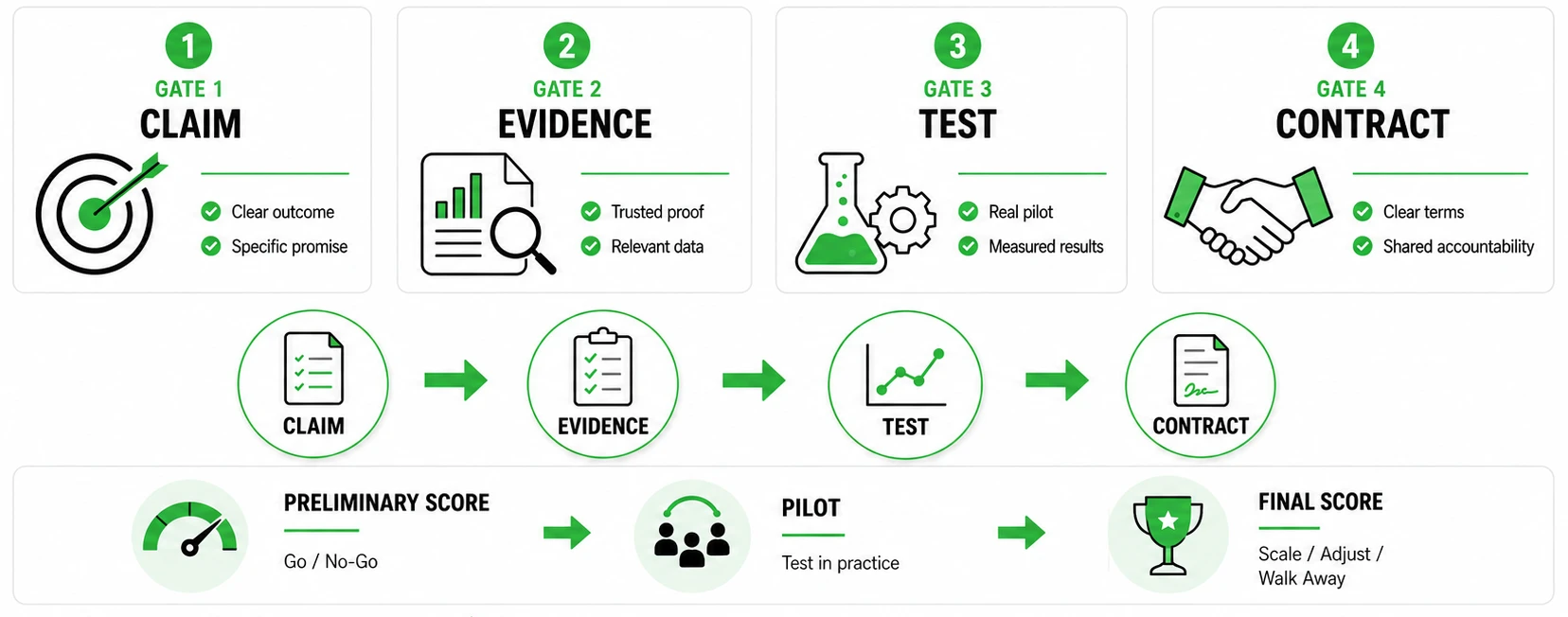
That is why a polished factory video, a successful sample demonstration and a list of familiar certificates are not enough. Procurement decisions should be based on an evidence chain:Claim → Evidence → Test → Contract.
For every supplier claim, request supporting evidence, verify it through a practical test, and convert the accepted result into a specification, acceptance criterion or contractual responsibility.
This guide provides a four-gate, 12-check due diligence method with a suggested 100-point score. It includes pause conditions, pilot validation and a two-stage decision process for comparing suppliers before a pilot and again before scaled production.
Quick navigation
•The short answer
•Four-gate scorecard
•RFI to scaled purchase order
•Company and factory audit
•Hardware and compliance
•Software, payments and data•Pilot, delivery and support
•Final pause review
•How to apply the checklist to Bajie Charging
•Frequently asked questions
The short answer: what should you check before selecting an OEM supplier?
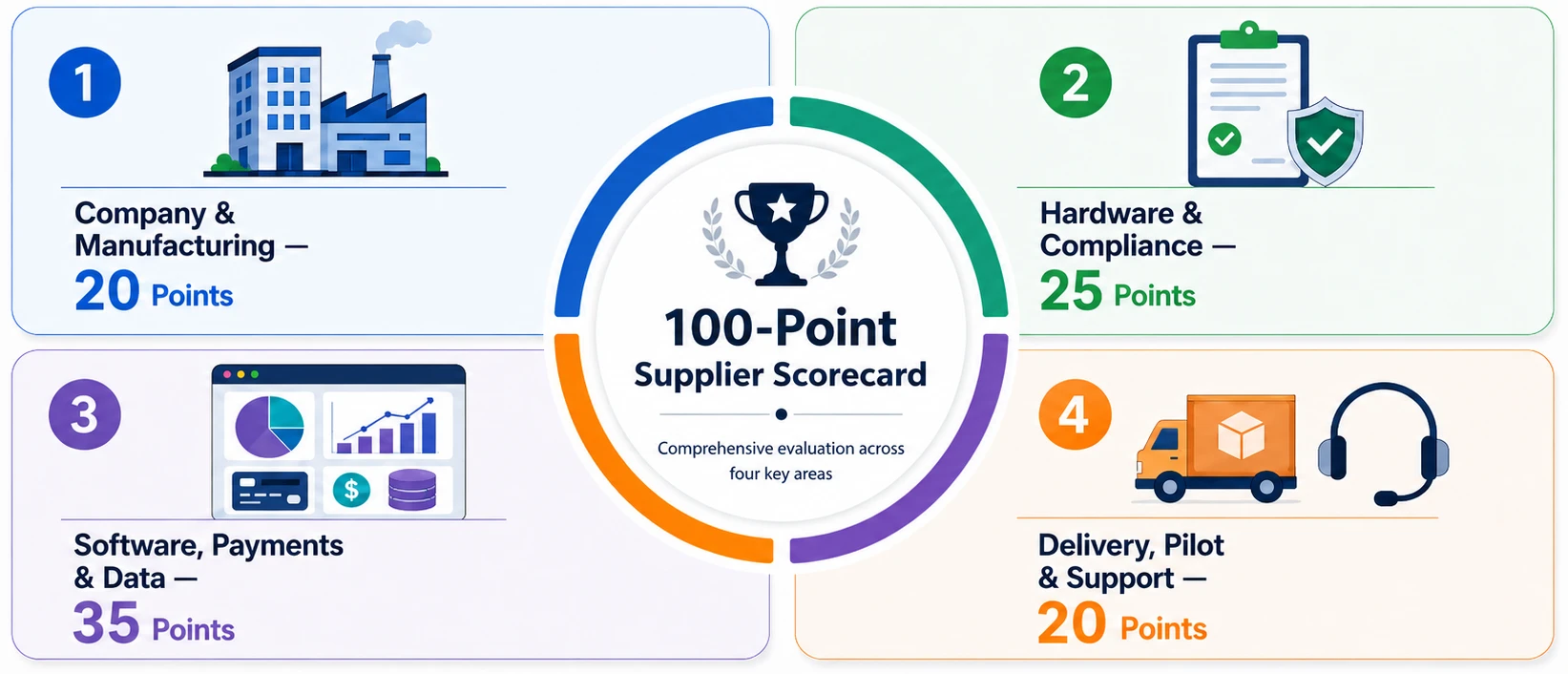
Audit the supplier in four areas:
1.Company and manufacturing — 20 points: legal identity, real production capability, quality control and traceability.
2.Hardware and compliance — 25 points: product-specific market documentation, lithium-battery transport readiness, reliability and serviceability.
3.Software, payments and data — 35 points: device-cloud integration, app and dashboard capability, localized payment lifecycle, security, ownership and exit rights.
4.Delivery, pilot and support — 20 points: sample-to-production consistency, change control, logistics, warranty, RMA, service levels and total cost of ownership.
A score should be issued twice:
•Preliminary score: assess document quality, live demonstrations, sample performance and contractual readiness. Score the readiness of pilot and support plans provisionally; do not treat future execution as already proven. Use this score only to shortlist pilot candidates.
•Final score: after the pilot, exception testing and a real support-case test, replace provisional judgments with observed results. Use the revised score to approve, condition or reject a scaled rollout.
Use the following thresholds at both stages, with the decision adapted to the stage:
80–100: eligible for the next stage, subject to closing remaining conditions.
•70–79: proceed only after documented corrective actions and re-verification.
•Below 70: do not advance to a pilot or scaled order without material remediation.
•Any critical pause condition: stop the purchase regardless of the total score until the issue is resolved.
These thresholds are decision aids, not guarantees. A supplier can score well overall and still be unacceptable if a required compliance document, payment path or data-exit clause is missing.
At the preliminary stage, award points for the evidence and tests available at that stage and mark future field-execution elements as provisional rather than failed. At the final stage, award full points only when the evidence is complete and the relevant field tests pass. Use partial points for documented, correctable gaps and zero when a claim cannot be verified. The downloadable scorecard provides separate preliminary and final fields.
If you are still evaluating the business model, costs or ROI, begin with How to Start a Shared Power Bank Business in 2026. If your main decision is white-label versus custom development versus SaaS, use the Shared Power Bank Software and App Guide. This article focuses specifically on OEM supplier audit, evidence and purchasing approval.
The four-gate OEM supplier scorecard
| TCO category | Costs to include |
|---|---|
| Initial system | Stations, power banks, branding, samples and tooling |
| Landed cost | Freight, dangerous-goods handling, insurance, duties and taxes |
| Compliance | Testing, documentation, registration, labeling and renewals |
| Software | Setup, subscription, cloud, maintenance and upgrades |
| Payments | Gateway, acquiring, cross-border, refund and chargeback fees |
| Third-party services | SMS, maps, email, app accounts, domains and SIM/data |
| Operations | Site visits, labor, redistribution, cleaning and training |
| Maintenance | Spares, repairs, batteries, cables and cross-border freight |
| Downtime | Lost rentals, merchant complaints and emergency replacement |
| Recall and continuity | Field action, replacement logistics and continuity costs |
| Change and integration | Custom features, APIs, gateways and compliance updates |
| Exit | Data export, migration, account transfer and replacement systems |
Pause procurement if any of the following cannot be resolved through evidence, testing and contractual commitments:
•The contracting, receiving, invoicing and manufacturing entities cannot be reconciled.
•Required compliance or lithium-transport documents cannot be matched to the exact product and battery configuration being purchased.
•Neither an end-to-end target-market payment verification nor a credible contracted integration plan is available.
•The supplier refuses to define data export, service termination and migration rights.
•The supplier will not lock the approved sample, key bill of materials or firmware baseline, and will not provide change notifications.
•Acceptance, warranty, RMA or serious-incident escalation responsibilities remain undefined.
Convert due diligence into a four-stage procurement path
| Stage | Purpose | Required output |
|---|---|---|
| RFI | Confirm legal identity, factory role and baseline capabilities | Evidence pack and initial pause-condition review |
| RFQ | Compare suppliers against the same configuration and commercial assumptions | Comparable quotation, exclusions and preliminary score |
| Pilot PO | Validate pilot units, payments, operations and support workflows | Pilot acceptance plan, issue log and decision report |
| Scaled PO | Release production only after final validation | Locked baseline, inspection plan and contractual remedies |
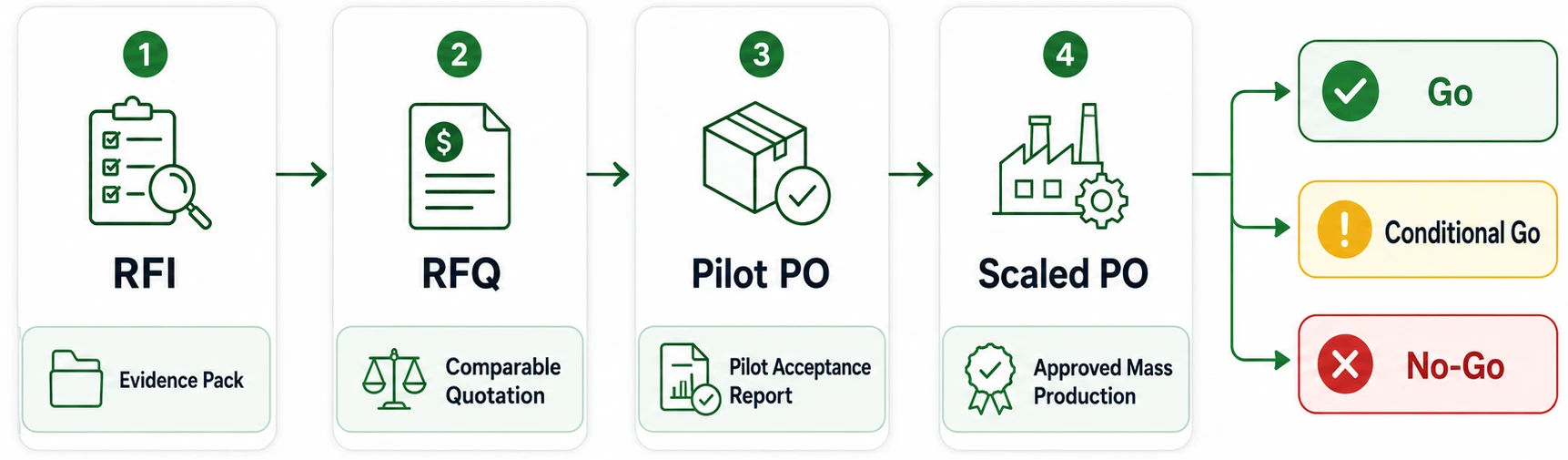
Supplier selection should move through four controlled stages.Each stage has a different purpose and should produce a documented approval before the next commercial commitment.
An RFI collects evidence; an RFQ compares commercial offers on the same basis. Paid samples and technical sample acceptance may occur during the RFQ stage, but they are distinct from a representative field pilot. The pilot purchase order then turns the preferred proposal into a controlled field test. A quotation or feature list is never a substitute for this process, and buyers should not move directly from RFQ to scaled production because one supplier appears cheaper.
•Exact hardware and battery configuration, included accessories and spare-parts package.
•MOQ, sample cost, tooling or NRE, volume tiers and quotation validity.
•Software setup, recurring fees, third-party costs, payment-integration scope and data-migration charges.
•Incoterm, packing, dangerous-goods handling, delivery assumptions and the event that starts lead time.
•Compliance-document scope, warranty, RMA, service levels, exclusions and change-control terms.
Use the same assumptions for every power bank rental stationOEM candidate. Otherwise, a low quotation may simply contain fewer deliverables or more exclusion.[Request a project review]
1.Verify the supplier type and legal identity — 5 points
Why it matters
A factory, trading company, software provider and local system integrator can all appear under the label “OEM supplier,” but they carry different responsibilities. The issue is not that one type is automatically better. The issue is whether the organization taking your money can control the product, software and support obligations it promises.
Questions to ask
Which entities will sign the contract, receive payment, issue the invoice and operate the factory or perform manufacturing?
Which entity owns, licenses or maintains the software platform?
Who is responsible for warranty, security incidents and payment integration?
Are any critical functions subcontracted? If so, to whom?
Evidence to request
Business registration, registered address and matching bank-beneficiary details.
Organization chart showing manufacturing, software and support responsibilities.
Written disclosure of critical subcontractors.
Authorization letters where one company sells or supports another company’s product.
How to verify it
Compare the legal names and addresses across the quotation, contract, invoice, bank account, product label, compliance documents and software terms. Ask one person to walk through the complete responsibility chain during a live meeting.[Request a project review]
Red flags
Payment is requested to an unrelated personal or company account.
The sales company cannot identify who owns the firmware or cloud platform.
The supplier refuses to disclose who actually manufactures the product.
2.Confirm the real factory, R&D capability and relevant project experience — 7 points
Why it matters
Shared power bank systems combine mechanical design, electronics, batteries, communications, firmware, cloud services and payment workflows. General electronics experience does not automatically demonstrate competence in rental-station operations.
Questions to ask
•Which design, firmware, testing and production activities are performed in-house?
•Can the supplier explain a real hardware, payment or fleet-management problem it solved?
•Who approves engineering changes and production release?
•Can you review an anonymized deployment reference or speak with a reference customer where permitted?
•Which critical components are single-sourced, and what is the continuity plan if a component or production site becomes unavailable?
Evidence to request
Live factory tour covering incoming inspection, assembly, functional test, aging or stress test, packing and nonconforming-product areas.
•R&D team structure and product-development process.
•Anonymized project records, change requests or issue-resolution examples.
•Production-equipment and calibration records relevant to the ordered product.
•Critical-component lifecycle status, approved alternatives, end-of-life notice periods and requalification process.
How to verify it
During a live shared power bank factory audit, choose the route rather than accepting a pre-edited tour. Ask the supplier to show a work order, batch label, test fixture and nonconforming-material process in real time. Request a technical meeting with the people who will support the project after the sale.[Request a project review]
Red flags
•Only marketing staff attend technical reviews.
•The supplier cannot explain how a rental order maps to a device action.
•References are impressive but unrelated to shared rental systems.
3. Audit production control, quality control and traceability — 8 points
Why it matters
A good sample proves that one unit worked once. It does not prove that the first production batch—or a later batch—will use the same components, firmware and test criteria.
Questions to ask
•How are incoming components inspected and approved?
•Which checks occur during assembly, final inspection and pre-shipment release?
•Can a field failure be traced to a production batch, component lot and test record?
•What requires a customer change notification?
Evidence to request
•Quality plan and inspection instructions.
•Incoming, in-process and outgoing inspection records.
•Serial-number and batch-traceability example.
•Calibration status for relevant test equipment.
•Defect, corrective-action and rework records, plus the approved supplier list for critical components.
How to verify it
Select a finished unit at random and ask the factory to retrieve its production and test records. Compare the sample bill of materials and firmware version with the proposed mass-production baseline. For larger orders, reserve the right to perform or commission a pre-shipment inspection.[Request a project review]
•“100% inspection” is claimed, but no test definition or record exists.
•Serial numbers do not link to production records.
•Critical components can be substituted without approval.
4.Match compliance and lithium-transport documents to the exact product — 12 points
Why it matters
“We have CE, FCC and UN 38.3” is not a complete compliance answer. Requirements depend on the target market, radio modules, power supply, battery design, product labeling and the exact configuration being shipped.
For the EU, CE marking is the manufacturer’s declaration that the product meets applicable EU requirements; there is no central EU authority that simply issues a universal CE certificate. Buyers should review the applicable legislation, EU Declaration of Conformity and supporting technical documentation—not just a CE logo or a voluntary certificate. The European Commission’s CE guidance also makes clear that products sold under your own name or brand may place manufacturer responsibilities on you.
In the United States, RF devices—including intentional and many unintentional radiators—generally must follow the applicable FCC equipment-authorization procedure before marketing or importation, subject to limited exceptions. Verify the Certification and/or Supplier’s Declaration of Conformity route for the complete marketed configuration, not only the radio module. Confirm the configuration against the FCC equipment-authorization guidance.
Lithium transport is a separate issue from market access. For normal commercial transport, lithium cell and battery types must have passed the applicable UN Manual of Tests and Criteria, Subsection 38.3 tests. Specific prototype or low-production movements may be possible only under applicable approvals and packing rules. Request the test summary and shipping documents for the actual battery design. The test summary must be made available upon request; it does not normally need to accompany every consignment as a paper copy unless a State or operator specifically requires it. See the IATA 2026 Lithium Battery Guidance Document.
Market access may also involve environmental, material, battery, packaging, waste and producer-responsibility obligations. Requirements such as RoHS, REACH, WEEE, battery registration or extended producer responsibility apply differently by market, product and commercial role. Include them in the target-market matrix only where applicable, identify who registers and reports, and confirm current obligations with official local sources and qualified specialists.
Questions to ask
•Which requirements apply in the target country and to this exact configuration?
•Do the reports cover the station, power supply, radio module and battery as applicable?
•Who is named as manufacturer, applicant or responsible party?
•Which documents will accompany the shipment or be available to the importer?
Evidence to request
•Market-specific compliance matrix prepared for the ordered configuration.
•Declaration of Conformity, test reports and technical documentation where applicable.
•FCC ID or supplier conformity records for the actual RF path where applicable.
•UN 38.3 test summary matched to the battery model and design.
•Safety data sheet where requested by the carrier, customer or applicable rules, plus the relevant dangerous-goods shipping records.
•Product/carton labels, user instructions and importer information.
•Environmental, battery, packaging, take-back and producer-responsibility records where applicable.
How to verify it
Build a document-to-product table containing the product name, internal model, battery model, radio module, report number, applicant, laboratory, issue date and scope. Compare these entries with the golden sample, label and bill of materials. Where risk or order value justifies it, ask a qualified local compliance specialist or test laboratory to review the file.[Request a project review]
Red flags
•A report has no clear product identifier or covers a different configuration.
•One certificate is used to explain multiple materially different products.
•UN 38.3 is described as a general quality certificate instead of transport testing.
•Required importer or labeling responsibilities are ignored.
•Environmental or recycling obligations are treated as a generic certificate rather than a market-specific operating responsibility.
IMPORTANT :This guide is not legal or regulatory advice. Confirm current requirements with qualified professionals in every target market before importing or placing products on the market.
5. Test hardware reliability, critical materials and serviceability — 13 points
Why it matters
Rental equipment operates repeatedly in unsupervised public environments. Reliability is not just battery capacity or shell material; it includes slot mechanics, locking, identification, communications, charging, thermal behavior, cables, power cycling and the time required to replace failed parts.
Questions to ask
•Which parts fail most often in the field, and what has been changed as a result?
•Which parts can be replaced locally without returning the complete unit?
•How are batteries, cables, locks, motors, communications and power components tested?
•What is the preventive-maintenance schedule?
How to verify it
Agree on a sample test plan before ordering. It may include repeated dispense and return cycles, power interruption and recovery, network loss and reconnection, wrong-orientation return attempts, slot recognition, charging-state accuracy, cable flex, lock resistance, remote reset and component replacement. Define the number of cycles and pass criteria for your project rather than accepting “tested” as a result.[Request a project review]
Red flags
•Ratings are quoted without a test method.
•The entire cabinet must be returned for common component failures.
•Outdoor suitability is claimed without an applicable test or defined operating limits.
6. Verify hardware–software–IoT integration — 8 points
Why it matters
A rental station is useful only when physical device actions, cloud records and payment status stay synchronized. Integration failures create stuck orders, incorrect billing, unavailable power banks and support tickets that are difficult to diagnose.
Questions to ask
•How does the platform identify stations, slots and power banks?
•What happens if the device loses power or network connectivity during a rental?
•How are duplicate commands, delayed messages and conflicting states handled?
Evidence to request
•System architecture and event-flow diagram.
•Device protocol or integration documentation appropriate to the engagement.
•Event logs for rental, return, charging, offline and fault states.
•Firmware release/rollback process and monitoring, alerting and audit-log examples.
How to verify it
Run a live exception demo, not just a normal rental. Disconnect the network, interrupt power, attempt a duplicate action, return a power bank after a delayed event and compare the physical outcome with the device log, order record and billing result.[Request a project review]
Red flags
•The supplier cannot show event logs.
•Device state and order state require frequent manual correction.
•Hardware and software teams blame each other during a failed test.
7. Audit the user app, operator dashboard, accounts and APIs — 7 points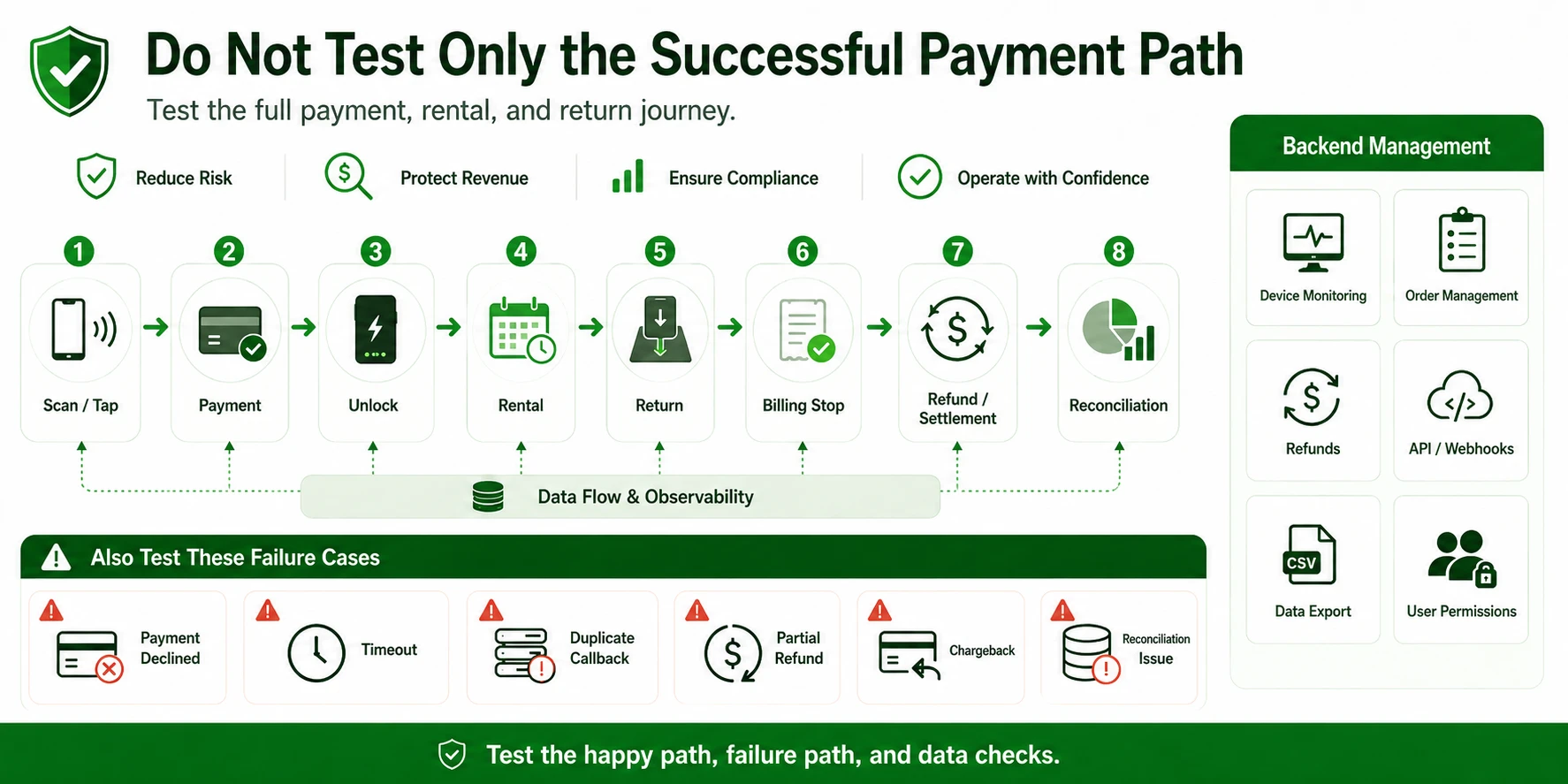
Why it matters
A branded interface is only one part of the software decision. Operators need tools for devices, stores, users, orders, refunds, pricing, revenue sharing, permissions, reporting and support. They may also need to integrate with existing ERP, CRM, finance or analytics systems.
For a detailed comparison of software delivery models, see the Shared Power Bank Software and App Guide. In this due-diligence step, focus on whether the supplier can prove and contract the selected capabilities.[Request a project review]
Questions to ask
•Which rental-entry and payment journeys are available: app, mobile web, QR, NFC, POS or other methods?
•Which roles and permissions exist, and can data be exported in a usable format on a defined schedule?
•Which APIs and webhooks are available, and how are they authenticated and versioned?
•Who owns the developer, domain, cloud and third-party service accounts?
Evidence to request
•Role-based live demonstration using several test accounts.
•Current functional specification, product roadmap, API documentation, sandbox access and sample webhook payloads.
•Export samples for devices, orders, payments, users and financial reports.
•App-store publishing and update responsibilities.
How to verify it
Use a scripted acceptance test. Create roles, change a price, bind a device, initiate a rental, issue a refund, export data, review an audit log and call at least one relevant API or webhook. Record what is standard, configurable, customized or unavailable.
Red flags
A screen mockup is presented as a working system.
“Open API” is claimed but no documentation or test environment exists.
Super-admin access remains permanently controlled by the supplier without a contractual reason.
8. Validate the complete local payment lifecycle — 10 points
Why it matters
“Integrated with a payment gateway” does not mean the gateway is available to your legal entity, currency and business model. Nor does it prove that pre-authorization, capture, refund, dispute and reconciliation work correctly in production.
A payment-channel count describes an integration pool, not universal availability. Local merchant eligibility, acquiring rules, settlement, technical credentials and compliance still need project-by-project confirmation.
For Bajie’s published payment architecture and channel categories, see Localized Payment Integration. The acceptance test below remains mandatory for the target market.[Request a project review]
Questions to ask
•Can the operator open the required merchant account in the target market?
•Who is the merchant of record and who receives the funds?
•Which currency is displayed, charged and settled?
•Does the rental use deposit, pre-authorization, direct charge or another model?
•How are refunds, partial refunds, reversals, chargebacks and failed returns handled?
•What payment data enters the OEM platform, and who carries the applicable security scope?
The PCI Security Standards Council states that PCI DSS applies to entities that store, process or transmit cardholder data—or can affect the security of the cardholder-data environment. Confirm the current requirements and division of responsibility using the official PCI DSS resources.
Evidence to request
•Target-market payment feasibility matrix.
•Gateway or acquirer onboarding requirements.
•Sandbox and production test plan.
•Transaction, fee, refund, payout and reconciliation examples.
•Security and responsibility matrix covering the operator, gateway and system provider.
How to verify it
Test the full lifecycle:
Payment lifecycle acceptance test
| Payment event | What to verify |
|---|---|
| Merchant onboarding | Your entity can legally and commercially open the account |
| Successful payment | Correct amount, currency, order and device action |
| Pre-authorization or deposit | Complete hold/release or deposit/refund flow |
| Failed or declined payment | No unintended dispense or open order |
| Timeout | Resolve uncertain status without duplicate charging |
| Duplicate callback | Idempotent processing; one order and one financial result |
| Refund / partial refund | Correct amount, status, timing and audit trail |
| Chargeback / dispute | Evidence and responsibility workflow are defined |
| Settlement | Entity, currency, fees and cycle match the agreement |
| Reconciliation | Gateway, order and finance reports can be matched |
Red flags
•Only the happy path is demonstrated.
•A global gateway logo is used without confirming local merchant eligibility.
•Funds are routed through the supplier without a clear legal and commercial structure.
•Refund and reconciliation depend on manual database changes.
•No one can explain PCI or payment-security responsibility.
9. Define data, intellectual property, security and exit rights — 10 points
Why it matters
Statements such as “you own the software” or “all data belongs to you” are too broad to support a contract. Core platform code, customized UI, app accounts, operational data, user data, domains, cloud infrastructure and third-party accounts may all have different ownership and license terms.
Data ownership also does not replace privacy obligations. Where the GDPR applies, controller and processor roles are determined by the actual purposes and means of processing, not only by the labels used in a contract. An organization may be a controller, processor or both for different activities. The European Commission notes that processor duties must be specified in a contract, including what happens to personal data when the contract ends. See the official controller-and-processor guidance.
Questions to ask
•Who owns or controls each account and asset during and after the contract?
•Is core source code transferred, licensed or retained by the supplier?
•Which data can be exported, in what format, how often and at what cost?
•Where is data hosted, backed up and replicated?
•What are the recovery time objective (RTO), recovery point objective (RPO), restore-test schedule and serious-incident notification commitment?
•Which subprocessors can access the data?
•What happens to service, data and integrations at termination?
Evidence to request
•Asset, account and rights matrix.
•Data-processing and security terms appropriate to the target market.
•Data-flow diagram, subprocessor list, authorization process and change-notification terms.
•Access-control, encryption, backup, incident-response and vulnerability-management summaries.
•Backup retention, restore-test evidence, failover arrangements and agreed RTO/RPO.
•Sample export and documented migration procedure.
•Service-termination, data-return and deletion clauses.
Contract ownership matrix
| Asset or account | Contract must define |
|---|---|
| Brand, logo and custom UI | Ownership and reuse rights |
| Core platform and source code | Transfer, license, restrictions and continuity |
| Custom code and integrations | Deliverables, repository access and maintenance |
| App-store developer accounts | Account holder, signing keys and release control |
| Domain, email, SMS and map accounts | Account holder, billing and transfer rights |
| Payment-gateway account | Merchant entity, credentials and settlement control |
| User and operational data | Roles, permitted use, export, retention and deletion |
| Analytics and logs | Access, retention and portability |
| Cloud infrastructure | Hosting party, region, backup and exit assistance |
How to verify it
Ask the supplier to export a complete test dataset and explain how a replacement system would import it. Review what happens if you stop paying, the supplier closes, the platform is acquired or a cloud region becomes unavailable. Run an account-access review using the proposed production ownership structure, and request evidence from a recent restore or continuity test.[Request a project review]
Red flags
•Ownership promises are not reflected in the contract.
•Data is technically exportable but only in screenshots or unusable summaries.
•App releases depend on a supplier-controlled account with no transition plan.
•Termination immediately removes access without a migration period.
•The supplier refuses to identify key subprocessors or hosting regions.
•Backup is claimed, but no restore test, recovery objective or serious-incident notification process can be shown.
10. Control sample-to-production consistency and pilot acceptance — 7 points
Why it matters
There are three different approvals:
1.Sample approval: the proposed product and system meet the specification.
2.Production approval: mass-produced units match the approved sample and controlled baseline.
3.Business acceptance: the complete system performs in real venues, networks, payment conditions and support workflows.
Passing one stage does not automatically pass the next.
Questions to ask
•Which physical unit will become the signed golden sample, and who controls it?
•Which key bill-of-materials items, firmware and software versions will be locked for production?
•Who can approve a deviation, and how will its compliance, cost and schedule impact be recorded?
•Who signs the pilot acceptance report, and which unresolved issues block scaled rollout?
•Who owns the pilot units and pays for installation, SIM/data, site work, travel, removal and return freight?
Evidence to request
•Signed requirement specification and approved golden sample.
•Locked key bill of materials, firmware and software baseline.
•First-article and pre-shipment inspection criteria.
•Pilot design, KPI definitions and issue log.
•Written rule for approving or rejecting deviations.
•Pilot commercial schedule covering equipment ownership, field costs, data access and end-of-pilot disposition.
How to verify it
For projects planning a scaled rollout, Bajie recommends considering a 50–100-station pilot after a preliminary supplier shortlist and written solution baseline have been approved, but before any scaled production order. This is not a universal minimum and should be adjusted to the target market, budget, venue mix and final rollout size. The purpose is to create enough operational variation to compare locations, workflows and failure modes—not to anchor the project around the cheapest possible test.[Request a project review]
Include several venue types and test placement within each venue. A main entrance can perform very differently from an emergency or waiting area in a hospital, or from a food court, service desk, waiting zone or high-dwell circulation route near restrooms in another venue. “Good venue” is too broad; the exact in-venue position must be measured.
Suggested pilot acceptance table
| Area | KPI or evidence | Decision question |
|---|---|---|
| Device availability | Online status and available charged units | Can users rent when demand occurs? |
| Rental execution | Successful dispense and order creation | Do physical and digital records agree? |
| Return recognition | Correct return, slot and billing stop | Are users charged accurately? |
| Payment | Success, failure, refund and reconciliation | Does the full local flow work? |
| Recovery | Power, network and device-fault recovery | Can common incidents be resolved remotely? |
| Location | Rentals by venue and exact placement | Which placements justify expansion? |
| Operations | Visits, labor time and spare-parts use | What is the real service burden? |
| Support | Response, diagnosis and closure records | Does the promised support process work? |
| TCO | Fees, repairs, downtime and replacements | Is the scaled model economically sustainable? |
Set thresholds from your business plan, service promise and venue economics. Do not borrow universal success rates without comparable market data.
Decide before the pilot: Go, Conditional Go or No-Go
Define the decision rule, KPI denominator, test period or transaction threshold, defect-severity method and retest process before deployment. Cover peak and off-peak periods as well as payment, network, return and support exceptions.
•Go: all critical conditions are closed, agreed acceptance thresholds are met, and no unresolved issue threatens compliance, payment, data control or scaled operations.
•Conditional Go: no critical pause remains, but limited remediable gaps have a named owner, deadline, retest method and temporary deployment cap. Expansion beyond that cap requires written closure.
•No-Go: a critical pause remains open, material defects recur after correction, or the payment, data, reliability or support model cannot meet the agreed requirement.
Record the result, exceptions, corrective actions and evidence in a signed pilot report. A high aggregate score must never override an unresolved critical condition.
Red flags
•The supplier refuses to identify an approved sample baseline.
•Pilot units use different components or software from production.
•Only aggregate rental revenue is reviewed; failure and support data are ignored.
•The supplier pressures the buyer to scale before payment and exception flows are stable.
11. Control customization, engineering changes, delivery and logistics — 5 points
Why it matters
Customization affects hardware, labels, packaging, app design, payment, software configuration and compliance documents. If scope and approvals are informal, the project can accumulate delays and charges while no one agrees on what “finished” means.
Questions to ask
•Which items are standard configuration, parameter changes, design changes or new development?
•What inputs and approvals are required from the buyer?
•How do changes affect price, compliance, testing and delivery?
•Which Incoterm, shipping mode and customs responsibilities apply?
•How are partial shipments and schedule changes handled?
Evidence to request
•Requirements matrix with owner and approval status.
•Artwork, UI, label and packaging approval files.
•Milestone plan from specification to sample, production, inspection and shipment.
•Engineering-change and commercial change-order process.
•Packing list, logistics plan and document checklist.
•Product-safety incident, recall, product-liability insurance and responsibility records appropriate to the project.
Put the approved solution into contract schedules
Attach the accepted requirements to the contract rather than leaving them in presentations, emails or chat records. Schedules should cover the technical specification, golden sample, controlled BOM and firmware baseline, software and payment scope, data and IP rights, compliance responsibilities, delivery and Incoterms, inspection, acceptance, warranty, RMA, spares, service levels, change control, product-safety incidents, recall and exit assistance.
Define what happens when a material obligation fails: corrective action, rework, retest, replacement, rejection, price credit, refund, expedited parts or another agreed remedy. Tie payment milestones to verifiable deliverables—such as sample approval, first-article approval, pilot acceptance and shipment inspection—not only to calendar dates. Do not copy a universal payment ratio; align the release of funds with the buyer's risk and obtain local legal advice on enforceability.
How to verify it
Run one controlled change during the sample phase. Check whether the supplier documents the request, impact, price, owner, approval and revised delivery date. Review the shipment plan with the party responsible for importing lithium-battery products.[Request a project review]
Red flags
The following are common OEM contract red flags:
•“Free customization” has no defined scope.
•Delivery time starts before required inputs are complete, creating misleading dates.
•Changes are implemented through chat messages without formal approval.
•The logistics quote omits dangerous-goods, customs or destination charges.
•The contract lists obligations but provides no acceptance, rejection, retest or remedy mechanism.
12. Compare warranty, RMA, spares, service levels and total cost — 8 points
Why it matters
Warranty duration is only one part of after-sales support. A multi-year warranty has little value if diagnosis takes weeks, replacement parts are unavailable, cross-border shipping is uneconomic or common failures are excluded.
Questions to ask
•When does the warranty start, and which parts and failure types are covered?
•Who pays diagnosis, parts, labor and two-way shipping?
•Which faults can be resolved remotely or by local technicians?
•What spare-parts ratio and replenishment method are recommended?
•How are severity, response, workaround, repair and closure measured?
•What support is available outside business hours, and is it customer service or engineering support?
Evidence to request
•Full warranty terms and exclusions.
•RMA workflow and sample case record.
•Spare-parts list, pricing and dispatch commitment.
•Severity-based service-level schedule.
•Escalation contacts and support-language coverage.
•Three-year total-cost model.
Compare total cost of ownership, not unit price
| TCO category | Costs to include |
|---|---|
| Initial system | Stations, power banks, branding, samples and tooling |
| Landed cost | Freight, dangerous-goods handling, insurance, duties and taxes |
| Compliance | Testing, documentation, registration, labeling and renewals |
| Software | Setup, subscription, cloud, maintenance and upgrades |
| Payments | Gateway, acquiring, cross-border, refund and chargeback fees |
| Third-party services | SMS, maps, email, app accounts, domains and SIM/data |
| Operations | Site visits, labor, redistribution, cleaning and training |
| Maintenance | Spares, repairs, batteries, cables and cross-border freight |
| Downtime | Lost rentals, merchant complaints and emergency replacement |
| Recall and continuity | Field action, replacement logistics and continuity costs |
| Change and integration | Custom features, APIs, gateways and compliance updates |
| Exit | Data export, migration, account transfer and replacement systems |
Compare three scenarios on the same assumptions
•Base: expected deployment, operating, failure and support assumptions.
•Downside: lower utilization, higher failure, delayed parts or additional field service.
•Scale: larger deployment with volume pricing, infrastructure growth and increased support load.
Document every assumption and source. Compare three-year total cost, cost per station-year and—once real pilot volume exists—cost per successful rental. The purpose is not to promise an exact return; it is to identify which supplier remains operationally and financially resilient when conditions change.
Use the Shared Power Bank ROI Calculator to connect the three-year cost view with deployment and revenue assumptions. Treat its output as a planning scenario, not a guaranteed return.
How to verify it
Open a test support ticket during the pilot. Record acknowledgment, technical diagnosis, workaround, parts decision, shipment and closure. Use the result—not the marketing phrase “24/7 support”—to evaluate operational readiness.
Red flags
•Support hours are not distinguished from engineering availability.
•Warranty exclusions are disclosed only after shipment.
•RMA requires returning complete cabinets for minor parts.
•No spare-parts plan exists for the target country.
•The supplier refuses to define serious-incident escalation.
Final pre-purchase pause review
Before releasing a pilot or scaled purchase order, confirm that every applicable statement below is true:
•☐ Legal, bank, invoice and manufacturing identities have been reconciled.
•☐ Compliance and transport documents match the ordered product, radio and battery configuration.
•☐ The target-market payment lifecycle has been verified end to end or a credible contracted integration plan exists.
•☐ Data export, account control, IP licensing, service termination and exit rights are contractual.
•☐ The golden sample, key bill of materials and firmware baseline are locked under controlled change notification.
•☐ Acceptance, warranty, RMA and serious-incident escalation responsibilities are defined.
An unchecked item does not automatically mean permanent rejection. It does mean procurement should pause until the gap is resolved through evidence, testing and contractual commitments.
Refusal to provide evidence, allow testing or document a critical obligation is a stronger warning than an ordinary correctable documentation gap.
Use the editable Shared Power Bank OEM Due Diligence Scorecard 2026 to record the 12 scores, critical pause conditions, evidence, preliminary and final assessments, corrective-action owners and three-year TCO. Download the scorecard.
Apply the same checklist to Bajie Charging
Bajie Charging’s public materials describe an integrated hardware, software, payment and support offer. Buyers should still test every relevant capability against their own configuration and contract.
| Published Capability | Public Evidence | What the Buyer Should Verify |
|---|---|---|
| 4,000 m² self-operated smart factory and OEM/white-label hardware customization | Hardware capabilities | Factory process, ordered configuration, quality records, traceability and product-specific reports |
| 300+ customized app projects; localization available for up to 120 languages | Software platform and the software selection guide | Required languages, translation QA, fonts, RTL support, app accounts, exception flows, API/export access and contractual deliverables |
| An integration pool covering 100+ payment channels | Payment integration | Target-country availability, merchant eligibility, currency, production onboarding, refunds, settlement and reconciliation; integration does not mean automatic availability in every market |
| 24/7 customer-service and after-sales intake; published three-year cabinet and one-year power-bank warranty | Support terms | Target-country availability, merchant eligibility, currency, production onboarding, refunds, settlement and reconciliation; integration does not mean automatic availability in every market |
Before a pilot order, Bajie Charging recommends matching the exact configuration to its reports and shipping documents, demonstrating the proposed app and dashboard, validating the target-market payment lifecycle, agreeing data and account rights, approving a golden sample, and defining the pilot and acceptance plan.
Request a guided project review
Send the following information before the meeting:
•Target country or countries.
•Expected initial and scaled quantities.
•Planned venue types and operating model.
•Preferred rental method: app, mobile web, QR, NFC, POS or a combination.
•Intended payment gateway or merchant account status.
•Branding and customization scope.
•Target launch date.
Bajie Charging can then review the hardware, software, payment, delivery and support requirements in a one-to-one video meeting or WhatsApp consultation. Depending on project maturity, the review can identify a proposed solution baseline, target-market payment feasibility questions, the evidence set still required and recommended pilot next steps. Any final capability, ownership, compliance, pricing or service commitment should be confirmed in the project specification and contract.
Choose the next action for your procurement stage
•Early research: Download the Shared Power Bank OEM Due Diligence Scorecard.
•Comparing suppliers: Submit your project brief or standardized RFQ.
•Reviewing a candidate solution:Request a guided one-to-one solution-fit review.
Final six-step purchasing process
1.Define the target country, business model, venues, rental path and scale.
2.Convert business needs into a written hardware, software, payment and support specification.
3.Screen suppliers for pause conditions, review documents, run demonstrations, approve samples and issue the preliminary score.
4.Select the strongest pilot candidate or candidates; incorporate the approved golden sample, controlled baselines, payment, data, acceptance and support terms into the contract schedules.
5.Complete the field pilot and, where applicable, pilot-batch or first-article inspections, exception tests and support-case test; close corrective actions and issue the final score.
6.Release a scaled production order only after the final score and all critical conditions meet the approved decision rule.
Frequently asked questions
1. What is the most important factor when choosing a shared power bank OEM supplier?
The priority is system-level delivery: hardware, software, local payments, data access, production control and support must work together. Strength in one area cannot offset a critical compliance, payment or exit-rights failure.
2. Is a factory audit enough to approve a supplier?
No. A factory audit verifies manufacturing and quality, not the complete software, payment, data or operating model. Combine it with document review, system acceptance, contract review and a representative pilot.
3. Which certificates should a shared power bank rental station have?
There is no universal list. Requirements depend on the market and exact configuration. Request a market-specific matrix and match every declaration, report and transport document to the ordered product.
4. Is UN 38.3 a product-market certification?
UN 38.3 addresses lithium-cell and battery transport testing, not universal market access or product quality. Obtain the applicable test summary and match it to the shipped battery design.
5. How do I verify that a payment gateway will work in my country?
Confirm merchant-account eligibility, then test currency, billing, success, decline, pre-authorization or deposit, refund, timeout, dispute, settlement and reconciliation. An integration logo is not proof of market readiness.
6. Who should own the app, software and customer data?
It depends on the contract. Define ownership, licenses, access and termination rights separately for the platform, custom code, UI, accounts, domains, payments, user data, operational data and exports.
7. How large should a shared power bank pilot be?
For a project intended to scale, Bajie recommends considering 50–100 stations across varied venues, placements, payment conditions and support cases. It is a suggested range, not a universal minimum.
8. Should I choose the supplier with the lowest price?
Choose on total cost and controlled risk. Include software, payments, third-party services, maintenance, spares, downtime, integrations and migration—not unit price alone.
9. How can I verify whether a shared power bank supplier is a real manufacturer?
Reconcile the contracting entity, bank account, invoice issuer and factory operator. Review the business registration, factory address, production records, equipment, quality controls and traceability during a live or on-site audit. Ask the supplier to disclose critical subcontractors and demonstrate the actual production steps for the ordered configuration. Factory ownership alone does not prove system capability, so software, payment and support must still be tested separately.
10. What is the difference between OEM, ODM and white-label supply?
In an OEM project, the supplier manufactures against an agreed specification or buyer-controlled design. In an ODM project, the supplier provides an existing design that may be modified for the buyer. White-label supply usually applies the buyer's brand to an established hardware and software platform with limited structural changes. Actual ownership, exclusivity and modification rights depend on the contract, not the commercial label.
11. What clauses should be included in a shared power bank OEM contract?
At minimum, define the exact configuration, golden sample, controlled BOM and software baseline, compliance responsibilities, payment integration, data and IP rights, acceptance criteria, engineering changes, delivery, inspection, warranty, RMA, spares, service levels, security incidents, termination and migration assistance. Also define remedies for delay, non-conformity, failed acceptance and unresolved defects.
Download the 2026 Shared Power Bank OEM Due Diligence Scorecard, Evaluate suppliers with 12 checks, 4 gates, and a 100-point scoring system.
July 21, 2026
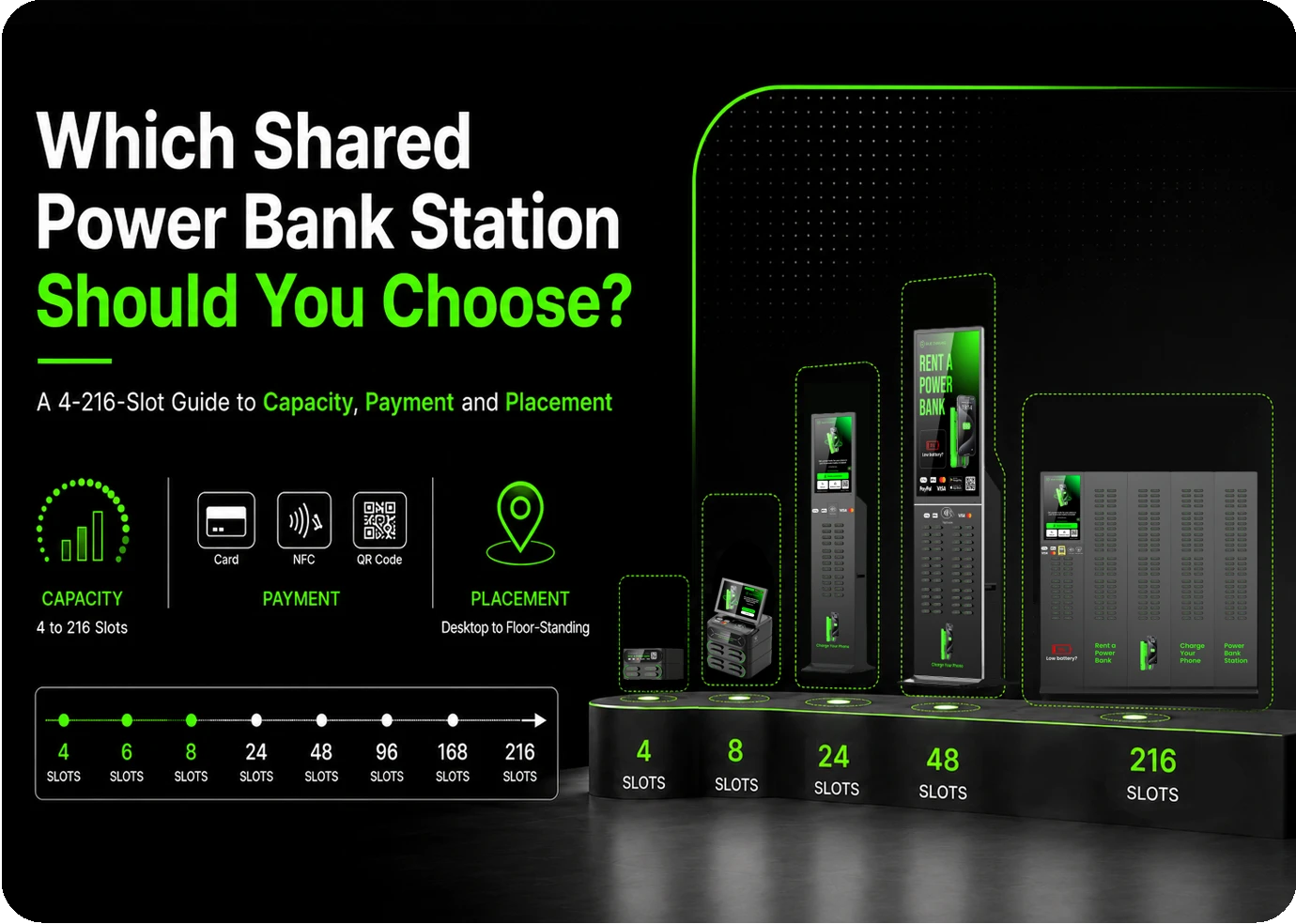 Which Shared Power Bank Station Should You Choose? A 4–216-Slot Guide to Capacity, Payment and Placement.
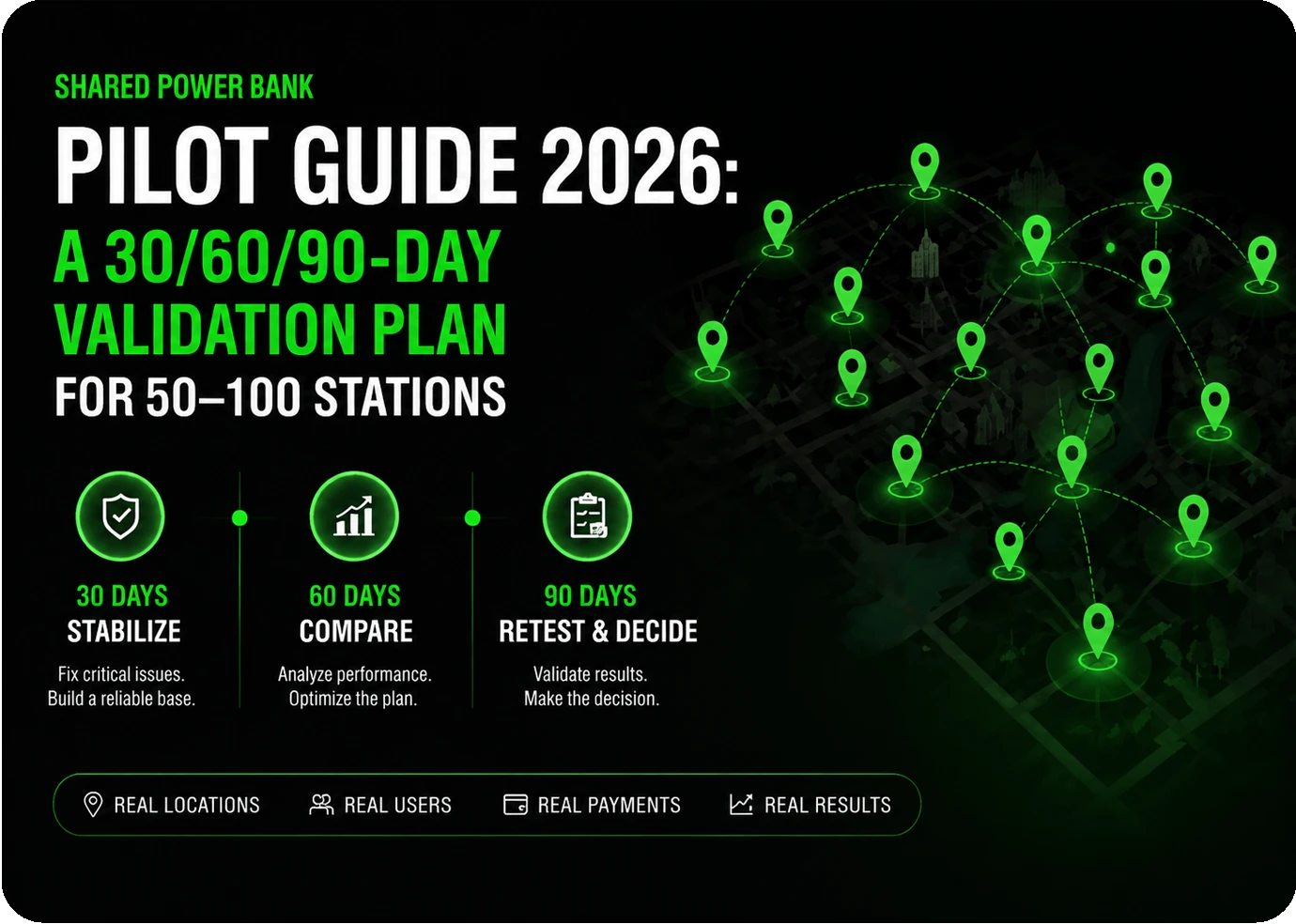 Shared Power Bank Pilot Guide 2026: A 30/60/90-Day Validation Plan for 50–100 Stations
 How to Choose a Shared Power Bank OEM Supplier in 2026: 12-Check Due Diligence Guide?
 What Is the Phone Charging Station Business?
 Power Bank Rental Software & App Guide 2026: White-Label vs. Custom Build vs. SaaS — What's Right for Your Business?
 How to Start a Shared Power Bank Business in 2026: Cost, ROI, Hardware, App & Payment Guide