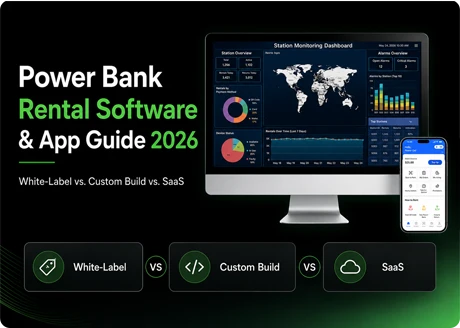
Power Bank Rental Software & App Guide 2026: White-Label vs. Custom Build vs. SaaS — What's Right for Your Business?
Table of Contents
1.Introduction: Why Software Is the Hidden Backbone of Your Power Bank Rental Business
2. Three Paths to Power: White-Label, Custom Build, and SaaS Solutions Explained
3. Essential Feature Checklist: What Your Software System Must Have
4. Payment Integration Deep Dive: The Gateway to Global Operations
5. Cost Comparison & Total Cost of Ownership (TCO)
6. How to Evaluate a Software Vendor: Key Questions
7. Conclusion: Choosing the Best Path for Your Business
8. FAQ
Introduction: Why Software Is the Hidden Backbone of Your Power Bank Rental Business
In the rapidly evolving shared economy, the success of a power bank rental business hinges not just on robust hardware, but critically, on the intelligence and efficiency of its underlying software system. While the physical power banks and charging stations are the visible face of your operation, it's the software that orchestrates every interaction, from user rentals and payments to device management and operational analytics. A well-chosen software solution can be the difference between a thriving enterprise and one that struggles with operational inefficiencies and poor user experience.
2.Three Paths to Power: White-Label, Custom Build, and SaaS Solutions Explained
Choosing the right software foundation is paramount for any shared power bank venture. Each of the three main approaches—White-Label, Custom Build, and SaaS—offers distinct benefits and drawbacks, catering to different business needs, budgets, and long-term visions.
2.1. White-Label Solutions: Rapid Deployment with Brand Customization
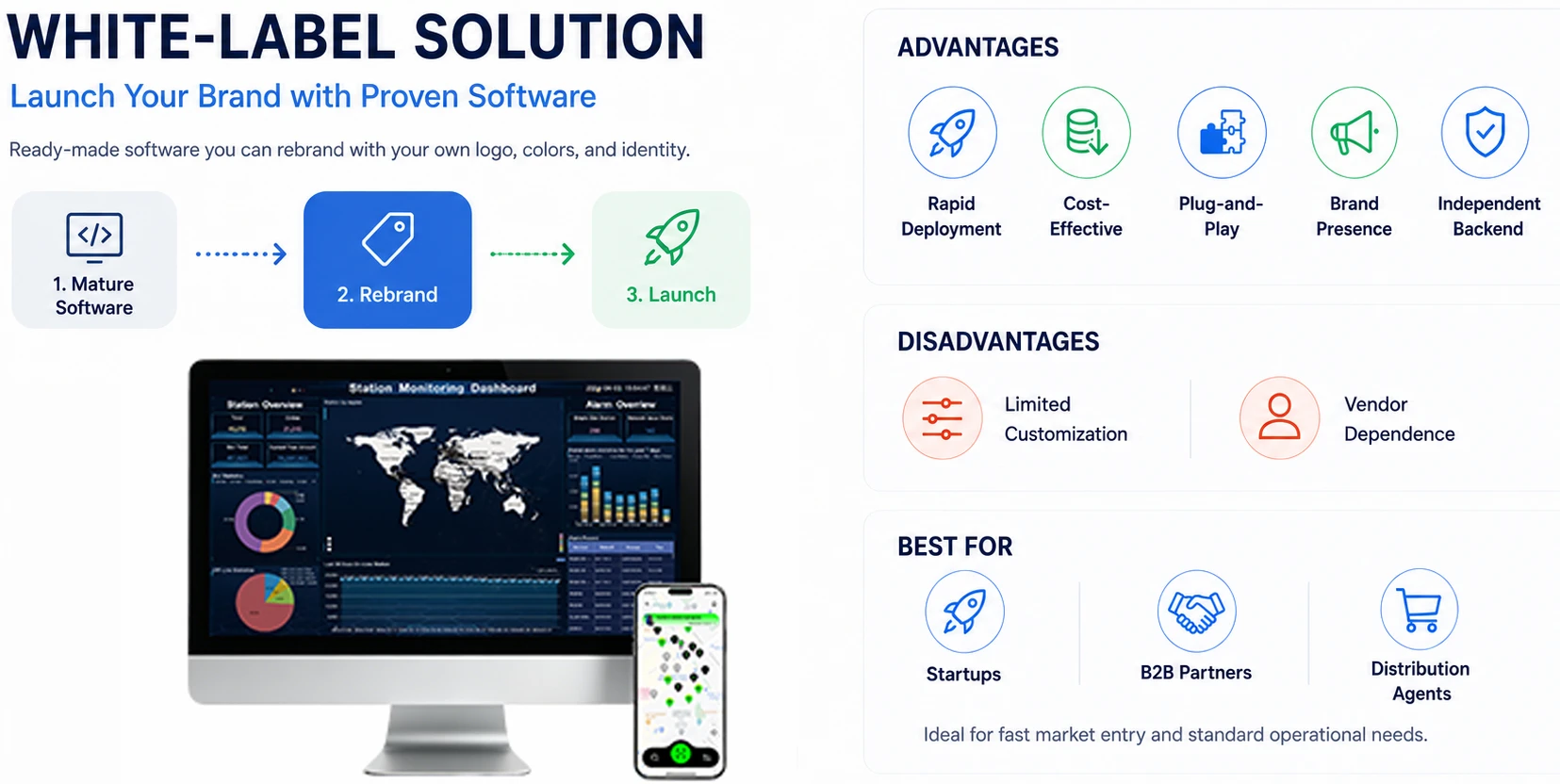
White-label solutions involve acquiring a pre-developed, mature software system that can be rebranded with your company's logo, color scheme, and other visual elements. This approach allows businesses to launch quickly without the extensive time and cost associated with ground-up development.
Advantages :
Rapid Deployment: Get your service up and running in a fraction of the time compared to custom development.
Cost-Effective: Significantly lower initial investment as development costs are spread across multiple clients.
Hardware-Software Synergy: Leading white-label providers already have their software deeply integrated with standard hardware protocols, ensuring "plug-and-play" deployment.
Brand Presence: While the core software is shared, the ability to customize the app icon, color scheme, splash screen, and merchant dashboard ensures your brand identity is front and center.
Independent Backend Instance: Many white-label providers offer an independent backend instance, ensuring your operational data, user information, and revenue data belong solely to you and are exportable at any time.
Disadvantages:
Limited Customization: Deep functional customization is often restricted, meaning you might have to adapt your business processes to the software's capabilities.
Vendor Dependence: Reliance on the software provider for updates, maintenance, and new features.
Best For: Startups, B2B partners, and distribution agents with a need for quick market entry and standard operational requirements. It's ideal for those who prioritize speed, cost-efficiency, and brand building over highly specialized niche features.
2.2. Custom Build: Tailored for Unique Business Models
Custom development entails building a software system from scratch, specifically designed to meet your exact business requirements. This approach offers unparalleled flexibility and control.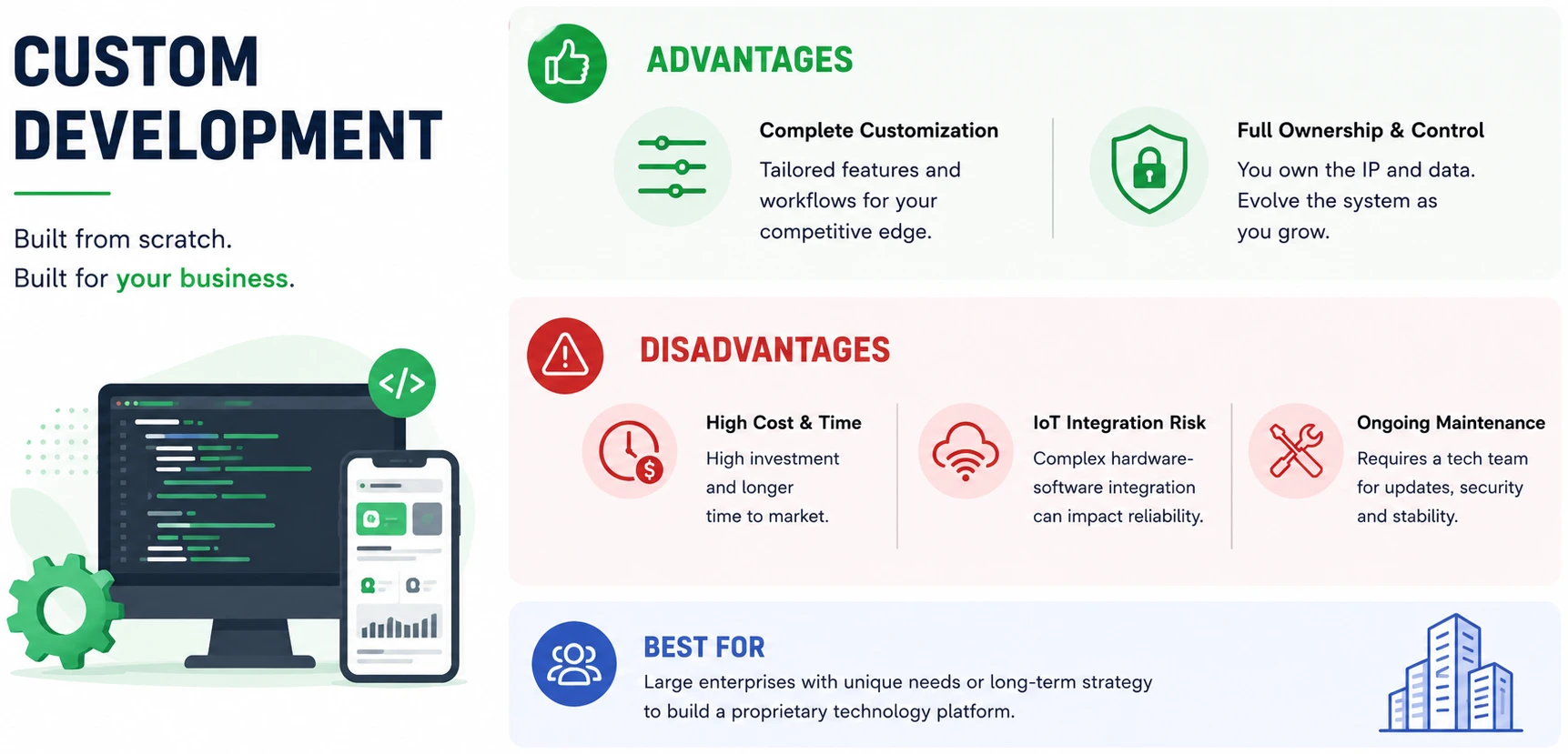
Advantages:
Complete Customization: Every feature, workflow, and integration can be tailored to your unique business model, providing a distinct competitive advantage.
Full Ownership & Control: You own the intellectual property, have complete control over data, and can evolve the system as your business grows.
Disadvantages:High Upfront Cost & Time: Significant initial investment in development, design, and infrastructure, delaying market entry.
The IoT Integration Trap: The biggest hidden risk is often not the app frontend, but debugging the underlying IoT communication (e.g., MQTT protocols, 4G/5G connectivity) and the physical control mechanisms for device ejection. Without proven hardware-software synergy, reliability plummets.
Ongoing Maintenance: Requires an in-house technical team or a reliable external development partner for ongoing bug fixing, security, and system stability.
Best For : Large enterprises with highly specialized operational needs, unique revenue models, or a long-term strategy to build a proprietary technology platform as a core asset.
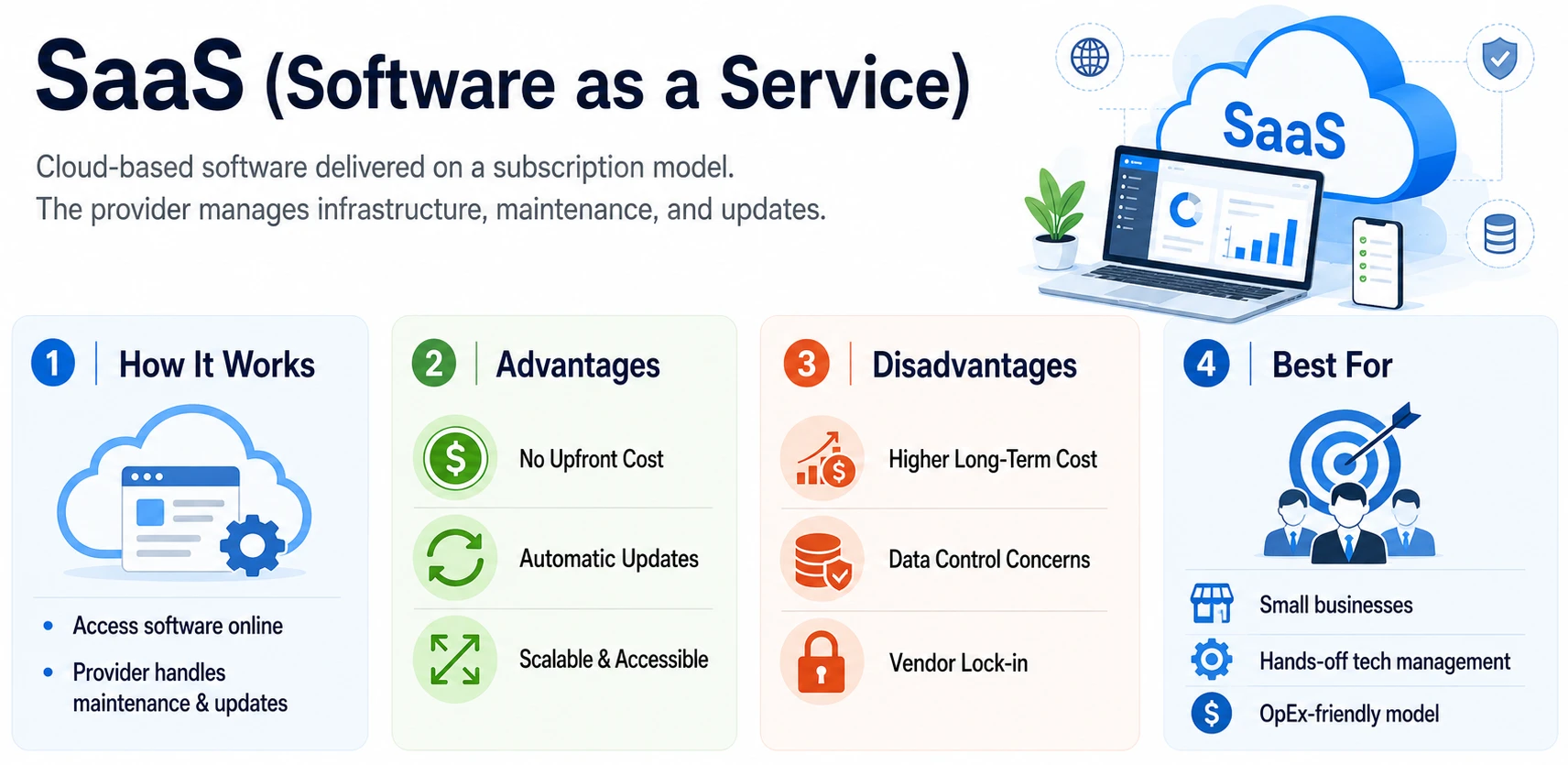
Software as a Service (SaaS) platforms provide cloud-based software on a subscription model. Users access the software over the internet, with the provider managing all infrastructure, maintenance, and updates.
Advantages :
No Upfront Development Cost: Pay a recurring subscription fee, eliminating large initial investments.
Automatic Updates & Maintenance: The provider handles all software updates, security patches, and infrastructure management.
Scalability & Accessibility: Easily scale your usage up or down as needed.
Disadvantages :
Long-Term Costs: Over time, cumulative subscription fees can easily exceed the cost of a white-label or even a custom-built solution, especially as your transaction volume and network size grow.
Data Control & Security Concerns: While providers typically offer robust security, some businesses may have concerns about data residing entirely on a third-party server.
Vendor Lock-in: Switching providers can be complex and costly.
Best For : Small businesses looking for a hands-off approach to technology management, comfortable with an operational expenditure (OpEx) model.
3. Essential Feature Checklist: What Your Software System Must Have
Regardless of the chosen solution, a robust power bank rental software system must encompass a comprehensive set of features to ensure smooth operations, superior user experience, and effective business management.
3.1. User-Facing App (Customer App)
A well-designed primary interface is crucial for intuitive and seamless power bank rental. Key features must include:
Multiple Quick Logins: Support for various login methods (e.g., phone number, social media, guest mode) to reduce friction.
Real-time Charging Status: Users can monitor their charging progress and remaining battery life.
Multilingual Support: Essential for expanding into diverse international markets.
Store Map & Navigation: An interactive map to locate nearby charging stations and provide navigation.
Wallet & Loyalty Programs: Integrated digital wallet for easy payments and loyalty programs for VIP users.
Cross-Platform Accessibility: The consumer side should ideally cover Android, iOS, and mobile H5/App Clips, allowing rentals even without a dedicated app download.
3.2. Merchant Backend (Station Owner/Operator Interface)
This interface empowers station owners and local operators to manage their power bank stations efficiently on the go.
Device Management: Real-time monitoring of charging station status, battery levels, and location tracking.
Revenue Reports: Access to real-time and historical revenue data, including withdrawal management.
Inventory Management: Tracking of power bank quantities and loss rates.
This is the central control hub for the entire power bank rental network. A mature, production-grade backend should include comprehensive modules:
Data Overview & Big-Screen Display: Provides key metrics like revenue with day-over-day deltas, trend charts, and breakdowns by device, store, and user.
IoT & Venues Management: Tools for managing cabinets, power banks, network status, and QR code binding. Includes remote functionalities like remote restart, OTA (Over-The-Air) updates, and forced remote eject.
Orders & Transactions: Detailed records of rental orders, pre-authorization records, top-ups, refunds, and commission reversals.
Advertising & Monetization: For systems with integrated cabinet screens, robust tools for managing ad assets, publishing logs, and playlists are vital to shorten the ROI cycle beyond just rental fees.
Multi-role Permission Management: Assigning different access levels for various team members
4. Payment Integration Deep Dive: The Gateway to Global Operations
As a common industry saying goes: "Most charging businesses don't fail on hardware. They fail on payments." A robust payment system ensures that the gap between a user wanting to pay and the operator receiving the funds is seamlessly bridged.
4.1. The Importance of Localized Payments
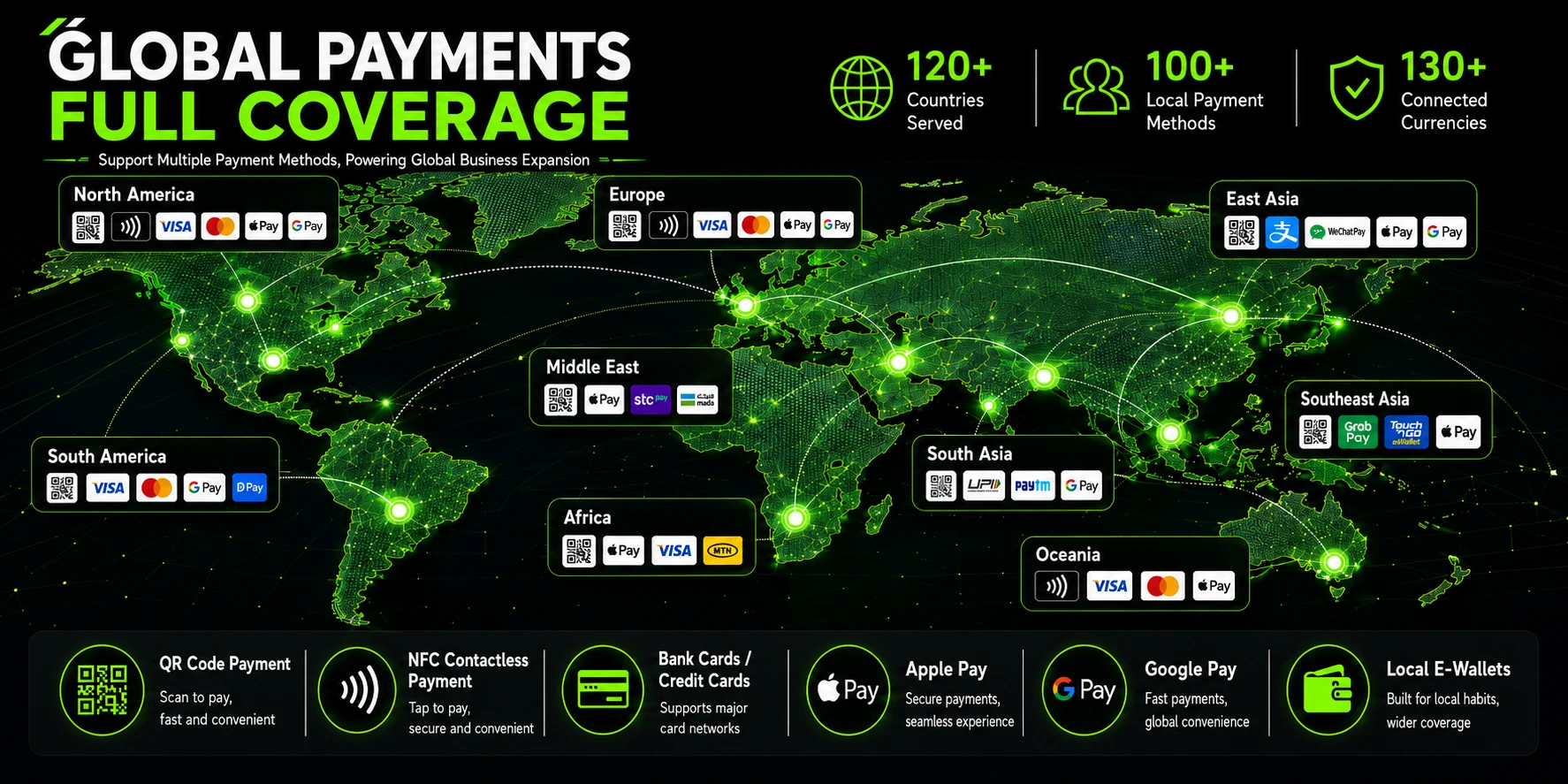
A user might reach for a power bank, but if their preferred local payment method isn't supported, the transaction fails. Localized payment solutions are not an afterthought; they are a default requirement for global expansion.
4.2. Diverse Payment Methods
To minimize friction, your software must support a wide array of payment methods globally:
NFC Tap to Rent: Utilizing Apple Pay, Google Pay, and standard NFC for the fastest, one-tap rental experience.
Credit & Debit Cards: Supporting major networks like Visa, Mastercard, Amex, JCB, and Discover.
Mobile Wallets & Regional Gateways: Integrating popular global wallets as well as crucial regional systems (e.g., WeChat Pay, Alipay, MercadoPago, or specific gateways like Mir and YooMoney depending on your target market).
QR Codes: Essential for markets where scanning is the primary payment behavior.
The system must flawlessly handle the complexities of payment success before unlocking the device. This involves pre-authorization (holding funds before the rental begins) and seamless settlement (capturing the final amount based on usage duration) automatically in the background.
5. Cost Comparison & Total Cost of Ownership (TCO)
White-Label: Typically involves a moderate initial setup fee and ongoing maintenance fees. The TCO is predictable and manageable, scaling well with your business without eating into profit margins like heavy SaaS models.
Custom Build: Requires a substantial upfront investment. While there are no subscription fees, ongoing costs for server hosting, bug fixes, and future feature development are significant and unpredictable.
SaaS: Features the lowest initial barrier to entry. However, the recurring subscription fees compound over time, potentially making it the most expensive option for high-volume, long-term operations.
6. How to Evaluate a Software Vendor: Key Questions
Selecting the right software partner is a strategic decision. Here are key questions to ask potential vendors:
1.What is your experience in the shared power bank industry, specifically regarding hardware-software IoT integration?
2.How customizable is your solution for B2B branding and white-labeling?
3.What global payment gateways do you currently support (e.g., Apple Pay, Google Pay, localized wallets)?4.How do you handle data security, GDPR compliance for privacy policies, and do your paired hardware solutions meet CE, FCC, and RoHS certification standards?
5.What level of technical support, agent training, and documentation do you provide?
6.What is your pricing structure, including all potential hidden fees (like transaction cuts)?
7.Do you offer an independent backend instance where I own and can export my data?
7. Conclusion: Choosing the Best Path for Your Business
The optimal software solution for your shared power bank business depends entirely on your specific circumstances, budget, and long-term strategy.
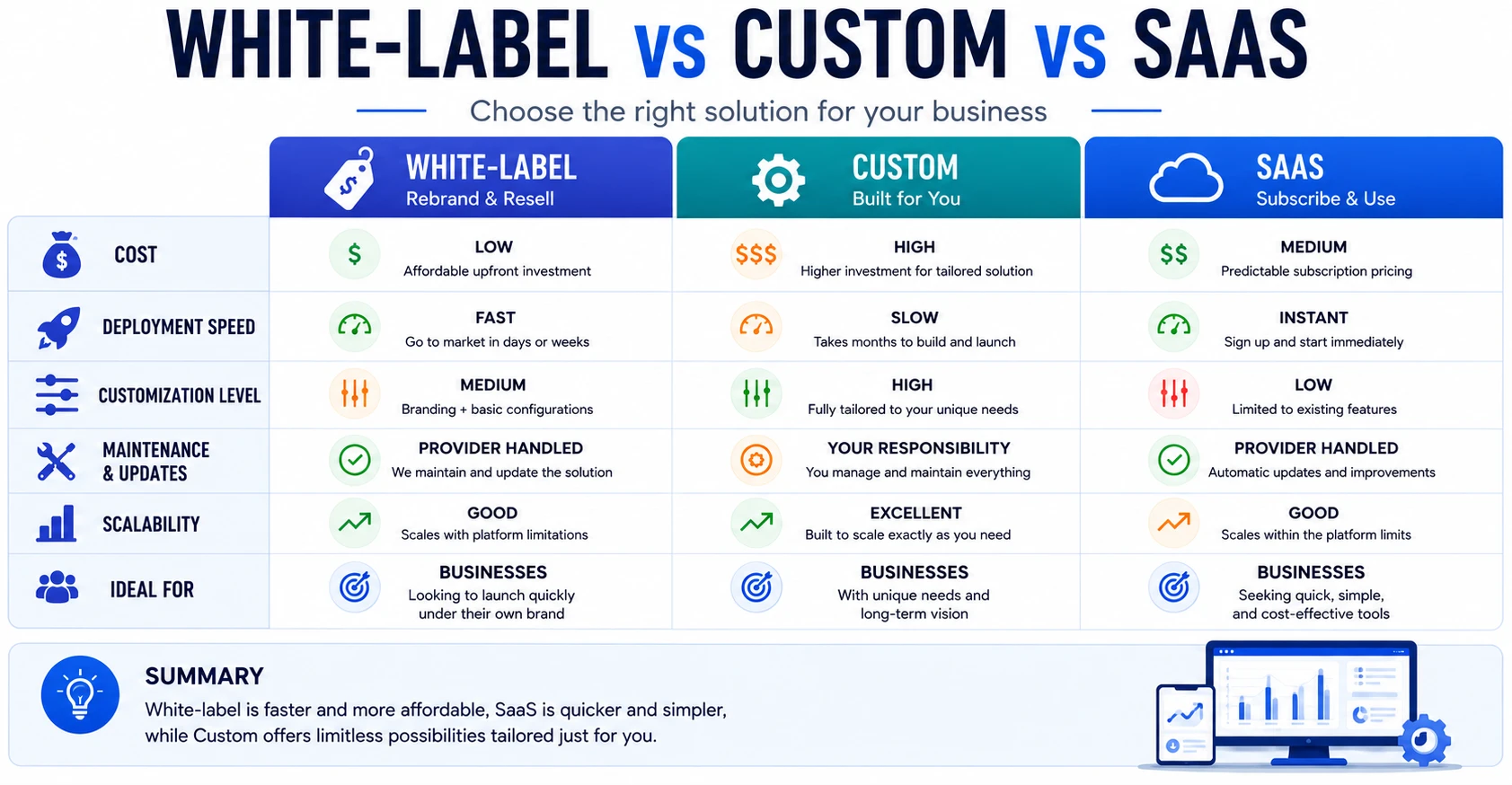
If you prioritize speed to market, cost-effectiveness, and a proven system with stable IoT communication while maintaining your brand identity, a White-Label solution is often the most pragmatic choice for B2B operators and agents.
If you have a highly unique business model and possess the capital and technical resources to manage complex IoT deployments, a Custom Build offers ultimate control. If you prefer a completely hands-off approach and are comfortable with a standard subscription model, a SaaS platform might be suitable for smaller, local operations.
8. FAQ
Q: What is the main difference between a White-Label App and a Custom App?
A: A white-label app is a pre-built, market-tested solution customized with your branding, offering faster deployment, reliable hardware integration, and lower costs. A custom app is built from scratch to your exact specifications, offering maximum flexibility but requiring significant time, higher risk in IoT integration, and larger investment.
Q: How much does it cost to develop a shared power bank app?
A: Costs vary wildly. A white-label solution might involve a reasonable setup fee plus manageable maintenance. A ground-up custom build can easily range from tens of thousands to over a hundred thousand dollars, depending on complexity and hardware integration requirements.
Q: How can I ensure payment security for my users?
A: Choose a software provider that integrates with reputable, PCI-DSS compliant payment gateways and utilizes secure, encrypted protocols for data transmission. Ensure their systems comply with regional data protection laws like GDPR.
Q: My business is small; which solution should I choose?
A: For small businesses or regional distributors, a White-Label or SaaS solution is generally recommended due to lower upfront costs and reduced technical management overhead, allowing you to focus your resources on venue acquisition and marketing.
Ready to launch or upgrade your power bank sharing business?
Choosing the right software shouldn't be a hurdle. Contact our expert team today to explore how our proven, globally compliant White-Label hardware and software solutions can help you capture your market faster and more profitably. [Contact Us / Request a Demo]
July 8, 2026
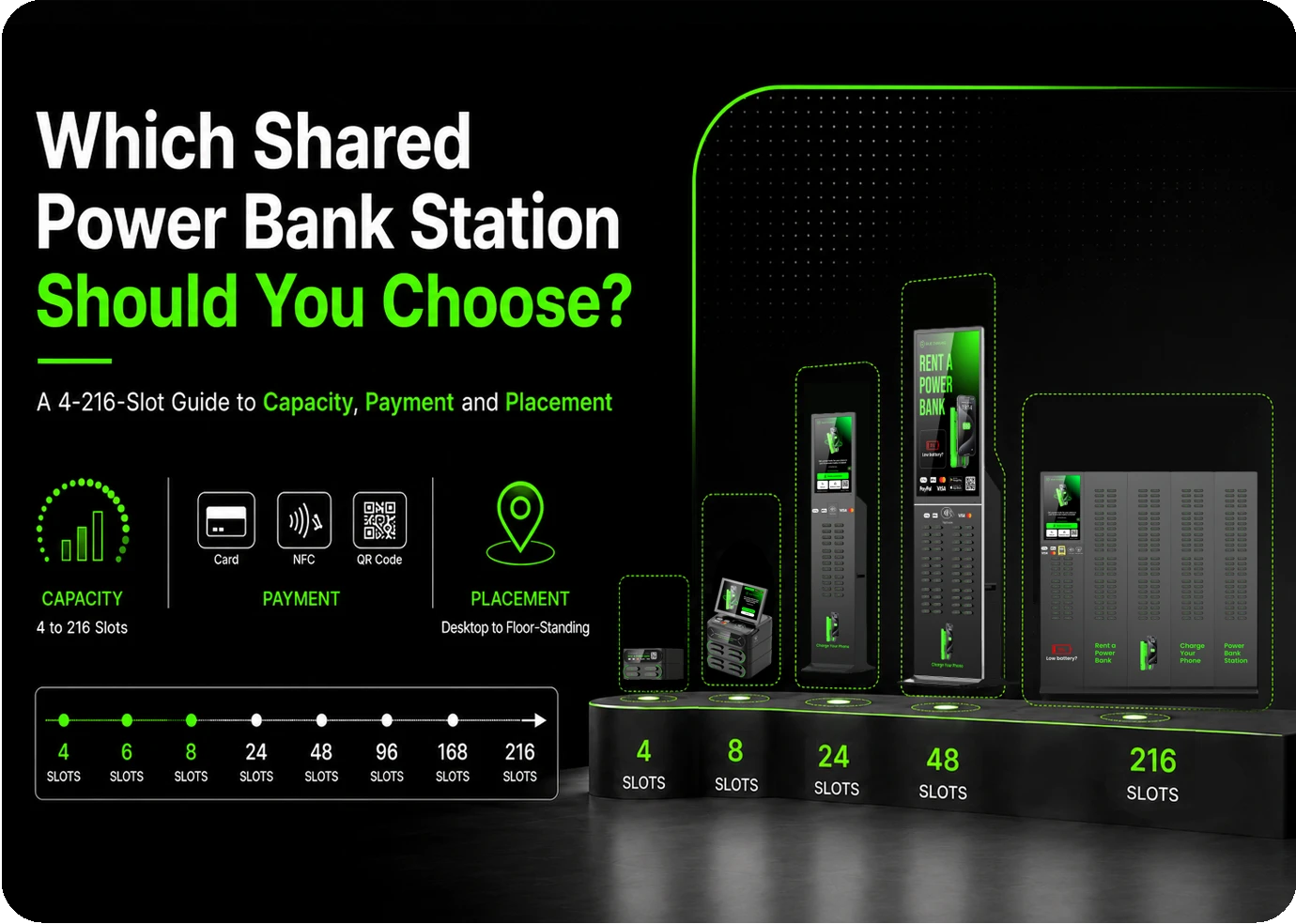 Which Shared Power Bank Station Should You Choose? A 4–216-Slot Guide to Capacity, Payment and Placement.
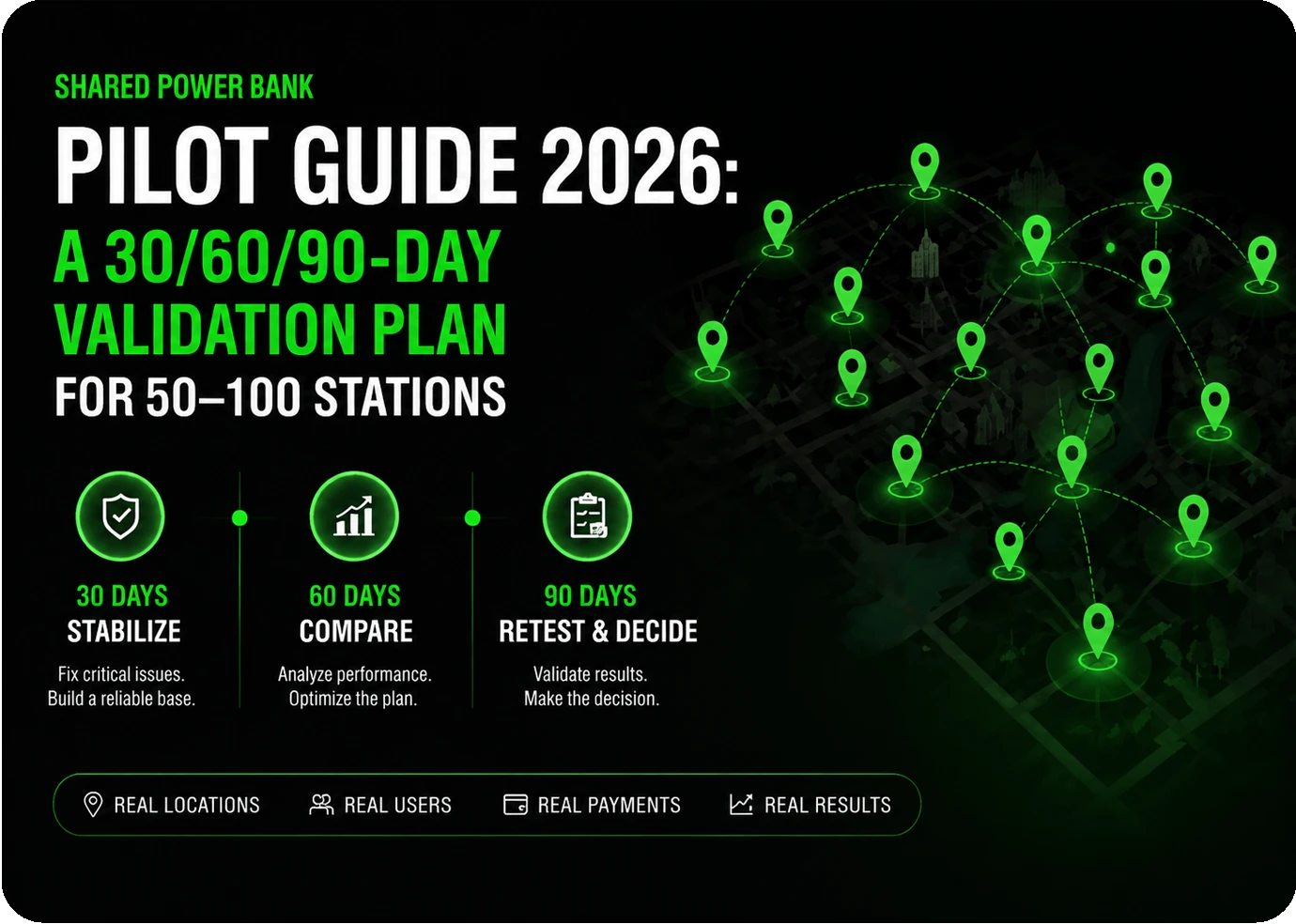 Shared Power Bank Pilot Guide 2026: A 30/60/90-Day Validation Plan for 50–100 Stations
 How to Choose a Shared Power Bank OEM Supplier in 2026: 12-Check Due Diligence Guide?
 What Is the Phone Charging Station Business?
 Power Bank Rental Software & App Guide 2026: White-Label vs. Custom Build vs. SaaS — What's Right for Your Business?
 How to Start a Shared Power Bank Business in 2026: Cost, ROI, Hardware, App & Payment Guide