How to Start a Shared Power Bank Business in 2026: Cost, ROI, Hardware, App & Payment Guide
Table of Contents
What Is a Shared Power Bank Business?
Step 1: Choose Your Market
Step 2: Choose a Business Model
Step 3: Calculate Your Startup Costs
Step 4: Model Your ROI
Step 5: Choose the Right Hardware
Step 6: Set Up Your Software System
Step 7: Deploy & Grow
FAQ
Why Shared Power Bank Rental Is a Global Business Opportunity in 2026
A traveler at Dubai International Airport watches his phone drop to 8% battery. A restaurant owner in Barcelona notices customers leaving because they cannot charge their devices. A young entrepreneur in Lagos sees long queues at the only public charging kiosk in a busy shopping mall. These three people share one thing in common: they have identified a problem that millions of people face every single day — and that problem is now a proven business opportunity.
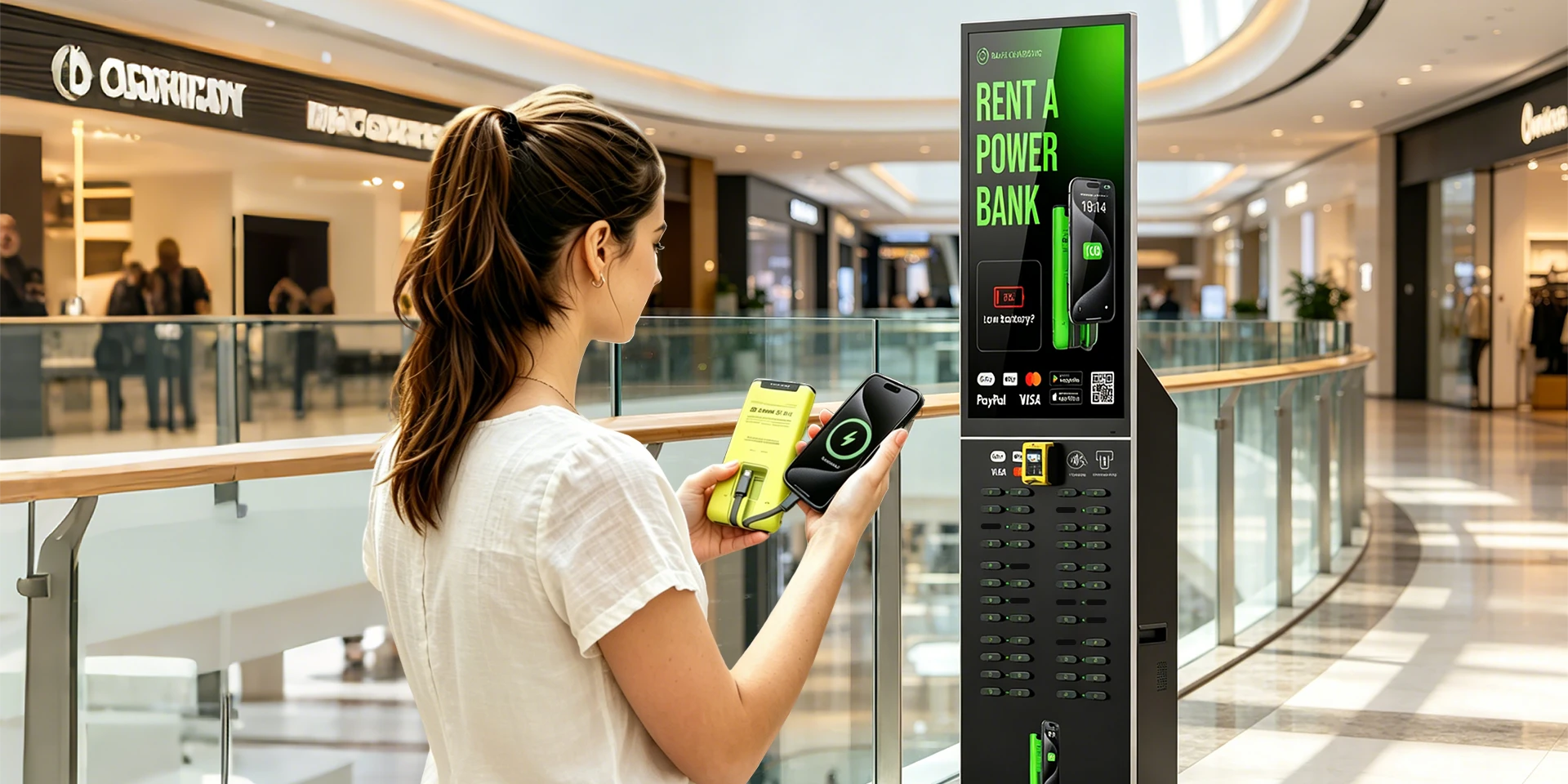
Shared power bank rental is not a new concept. In China, the industry has already generated billions in annual revenue, with over 900 million cumulative users. But outside China, most markets remain in the early stages. In Europe, the Middle East, Southeast Asia, Latin America, and Africa, the infrastructure gap is enormous — and that gap represents a window for entrepreneurs, local operators, and investors to build profitable businesses from the ground up.
Three signals make 2026 the ideal year to enter this market. First, aviation authorities in India, Australia, Singapore, and several other countries have implemented restrictions on carrying personal power banks onto aircraft, driving a surge in airport rental demand. Second, the global shared charging market is projected to reach $9.3 billion by 2030, growing at a compound annual rate of 13.7%, with the fastest growth happening outside China. Third, manufacturing costs have dropped significantly — OEM factory capacity has expanded, and per-unit hardware costs are 20–30% lower than they were in 2022.
This article provides a complete, step-by-step guide to launching your shared power bank rental business in 2026. It covers market selection, business models, startup costs, ROI calculation, hardware choices, software and payment systems, deployment strategy, and common mistakes to avoid. Whether you are planning to start with 10 stations in a single city or scale to 500 stations across a country, this guide gives you the framework to make informed decisions.
What Is a Shared Power Bank Business?
A shared power bank business allows users to rent portable battery packs from automated stations placed in public venues. The user takes the power bank, charges their phone on the go, and returns it to any compatible station within the network. The system automatically tracks rental duration, calculates fees, and processes payment.
It is important to understand the distinction: the charging station itself does not charge the user's phone directly. The station stores, charges, identifies, and dispenses power banks. The power bank is what the user takes away to charge their device.
A complete shared power bank business system includes:
•Charging stations — hardware units that store and dispense power banks
•Rental power banks — portable batteries with built-in cables (Lightning, USB-C, Micro-USB)
•User app or H5 rental page — the interface users interact with to rent and return
•Payment gateway or POS terminal — processes transactions (credit card, NFC, QR, Apple Pay, Google Pay)
•Admin management system — the backend dashboard for operators to monitor stations, revenue, and users
•Merchant and station network — the physical locations where stations are deployed
For the operator, this creates a recurring revenue stream: every rental generates income, and in high-traffic locations, a single station can process dozens of transactions per day.
How Does the Power Bank Rental Process Work?
The rental process is designed to be frictionless for end users, typically completed in under 30 seconds:
1Initiate rental — The user scans the QR code on the station, opens the mobile app, taps their NFC-enabled card, or uses a POS card reader at the venue.
2Complete payment — The user pays a rental fee or deposit via credit card, Apple Pay, Google Pay, local mobile wallet, or QR code payment. The exact method depends on the market and system configuration.
3Station unlocks — Once payment is confirmed, the station automatically unlocks and ejects one fully charged power bank.
4User charges their phone — The user takes the power bank and connects it to their device using the built-in cable. Most rental power banks support Lightning, USB-C, and Micro-USB simultaneously.
5Return at any station — When finished, the user inserts the power bank into any compatible station in the network. There is no requirement to return it to the original location.
6Automatic settlement — The system calculates the rental duration, deducts the appropriate fee, and processes any deposit refund automatically.
This simplicity is what drives high conversion rates. Users do not need to download an app in advance (H5 web pages work), do not need to create an account (guest checkout is possible), and do not need to return the power bank to the same location. The lower the friction, the higher the rental frequency.
Step 1: Choose the Right Market for Your Power Bank Rental Business
The most common mistake new operators make is buying hardware before choosing a market. Different countries have vastly different payment habits, competition levels, regulatory requirements, and consumer spending power. The market you choose determines everything — from which hardware model you need to which payment gateway you must integrate.
Five Criteria for Market Selection
1. Smartphone penetration rate — A minimum of 65% smartphone penetration is the baseline. Below this threshold, the addressable user base is too small for a rental model to work efficiently.
2. Mobile and digital payment adoption — This determines your user experience path. In markets where NFC and contactless payments dominate (UK, Netherlands, Australia), you need POS-integrated stations. In markets where QR code payments are standard (Southeast Asia), app-based or H5 rental works best.
3. Existing competition density — Some markets already have established players (China, South Korea). Others have zero or minimal competition (most of Africa, Central Asia, parts of Latin America). Early entry into low-competition markets allows you to secure prime locations before others arrive.
4. Public venue infrastructure — Are there large numbers of restaurants, shopping malls, hotels, airports, universities, and entertainment venues? These are your deployment targets. Markets with dense commercial districts offer more placement opportunities.
5. Regulatory environment — Some countries require import licenses for electronic devices. Others have specific data privacy regulations (GDPR in Europe) that affect how your app handles user information. Check local requirements before committing.
Market Categories
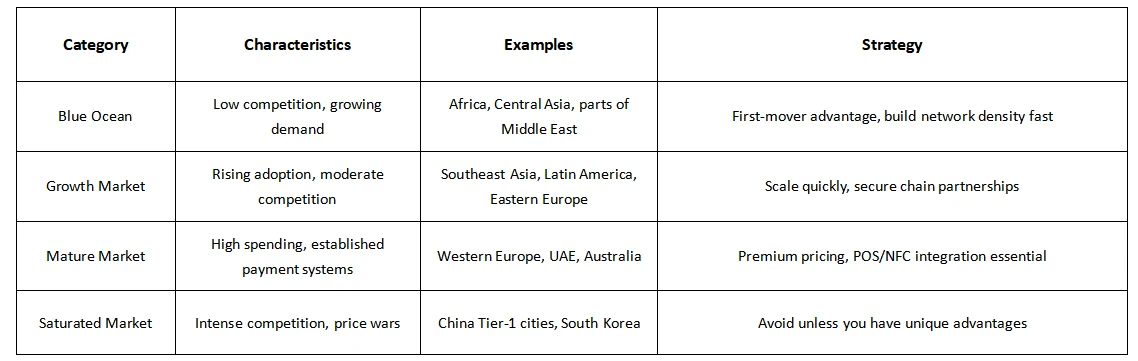
Country Examples
UAE / Dubai — High consumer spending, massive tourism traffic, low competition in shared charging. Credit card and Apple Pay are dominant. Ideal for premium pricing ($2–3/hour).
Thailand / Vietnam — Extremely high smartphone usage, QR code payment is standard, large numbers of restaurants and malls. Volume strategy works well at lower price points ($0.5–1/hour).
Germany / UK — Strict regulatory environment but excellent payment infrastructure. Users expect contactless card payment. Higher margins but longer sales cycles for venue partnerships.
Step 2: Choose Your Power Bank Rental Business Model
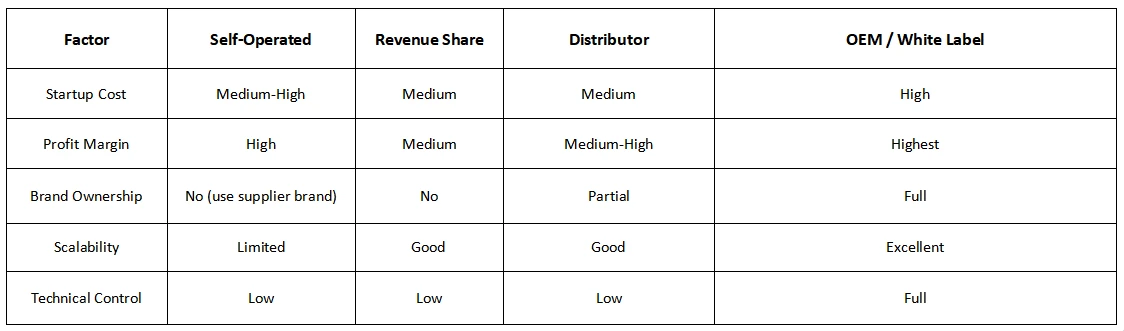
Before purchasing any equipment, you need to decide how you will operate. There are four primary business models, each suited to different resource levels and growth ambitions.
Model 1: Self-Operated
You purchase all hardware, negotiate venue placements yourself, and retain 100% of rental revenue (minus venue share). This requires the most capital and local resources but offers the highest long-term profit margins.
Best for: Entrepreneurs with local business networks, existing venue relationships, or experience in retail/hospitality operations.
Model 2: Merchant Revenue-Sharing
You provide stations to venue owners (restaurants, hotels, malls) and split rental revenue — typically 70/30 or 80/20 in the operator's favor. This reduces upfront venue costs and aligns incentives.
Best for: Operators who want to scale quickly without paying fixed rent for each location.
Model 3: Distributor / Agent
You become the regional distributor for a brand, purchasing hardware at wholesale prices and either operating stations yourself or recruiting sub-agents. You may earn from both hardware resale margins and ongoing revenue shares.
Best for: Experienced distributors with multi-city networks or channel resources in target markets.
Model 4: OEM / White Label (Bajie's Core Offering)
You work with an OEM manufacturer to create your own branded system — custom logo on hardware, your own app with your brand name, your own backend dashboard, and your own payment gateway. You own the brand, the data, and the customer relationships.
Best for: Serious operators building a country-level or regional brand. This model offers the greatest long-term business value and exit potential.
Want to launch under your own brand? Bajie Charging provides complete OEM and white-label power bank rental solutions — including hardware, app, backend system, payment integration, and ongoing technical support. Shared Power Bank Rental System | Global Supplier - BAJIE CHARGING !
Step 3: Calculate the Startup Cost of a Shared Power Bank Business
One of the most common questions from potential operators is "How much does it cost to start?" The honest answer is: it depends on your market, scale, hardware selection, and customization requirements. But we can break down the cost structure so you can build your own budget.
Cost Components
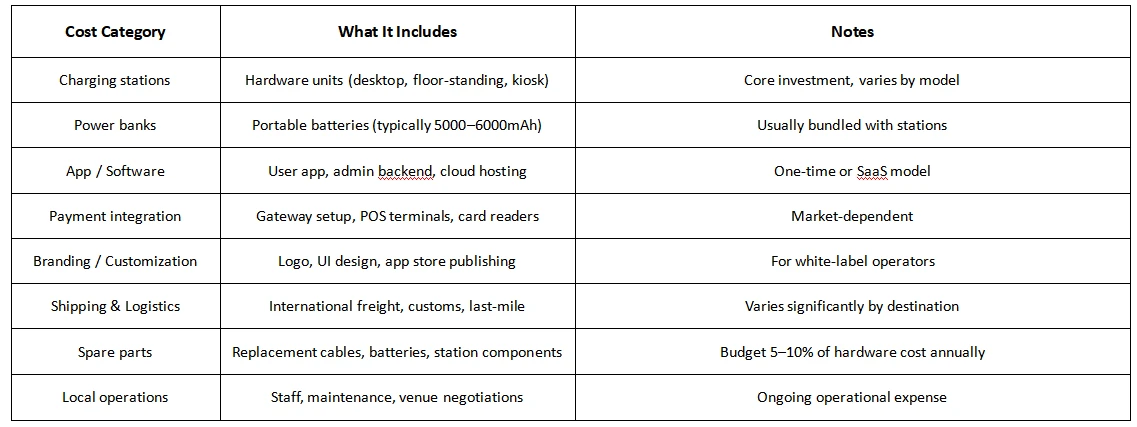
Scale-Based Budget Ranges
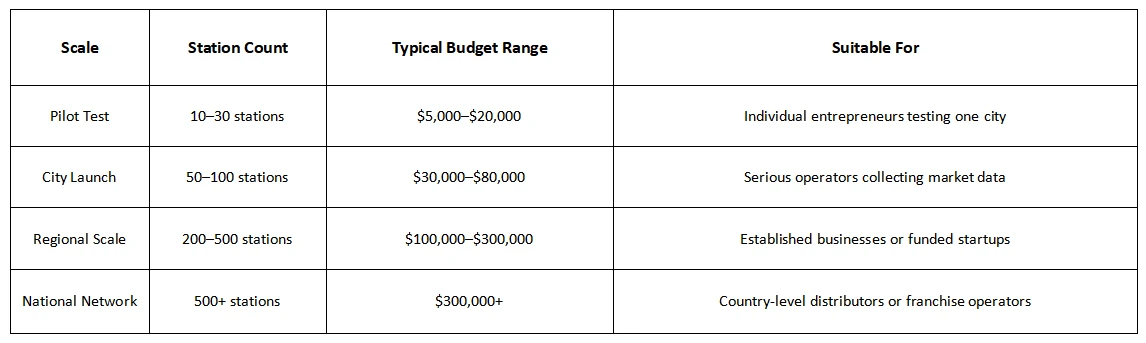
Important note: A meaningful market test requires at least 50 stations deployed across multiple venue types. Testing with only 2–3 stations does not generate enough data to validate the business model in your market. Users need a network of return points to feel confident renting.
Cost Reduction Strategies
•OEM bulk purchasing reduces per-unit hardware cost by 15–25%
•Revenue-sharing with venues eliminates fixed rent costs
•SaaS software models reduce upfront technology investment
•Phased deployment allows you to reinvest early revenue into expansion
Step 4: Build Your Power Bank Rental ROI Model
Profitability in shared power bank rental is driven by a simple equation, but the variables within that equation differ dramatically based on location quality, pricing strategy, and operational efficiency.
Revenue Formula
Estimated Monthly Revenue =Average Daily Rentals per Station × Average Rental Fee × Number of Stations × 30 Days
Profit Formula
Estimated Monthly Profit =Rental Revenue + Advertising Revenue − Operating Costs − Merchant Share − Payment Processing Fees
Key Variables That Determine ROI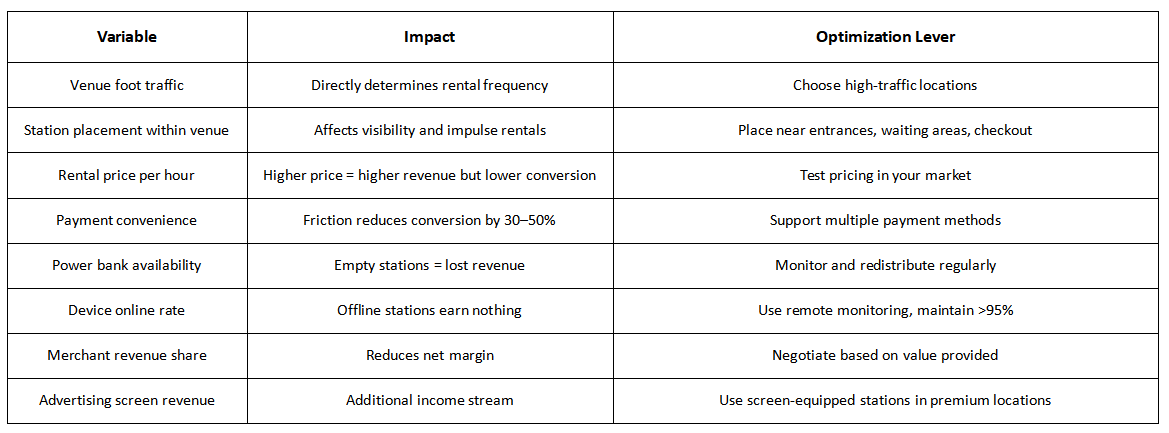
ROI Scenario Example
For illustration purposes (actual results vary by market):
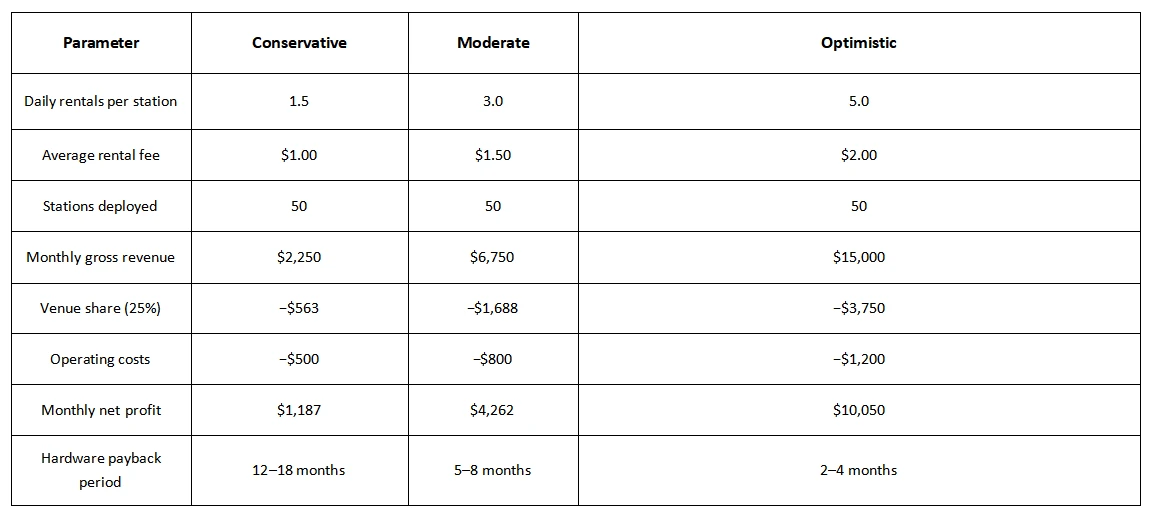
These numbers are illustrative. Your actual ROI depends on your specific market conditions, venue quality, and operational execution.
Need a custom ROI projection for your target market? Share your country, station quantity, rental price, and venue type with Bajie Charging — we can help you build a practical financial model. Shared Power Bank Rental System | Global Supplier - BAJIE CHARGING !
Step 5: Choose the Right Power Bank Rental Hardware
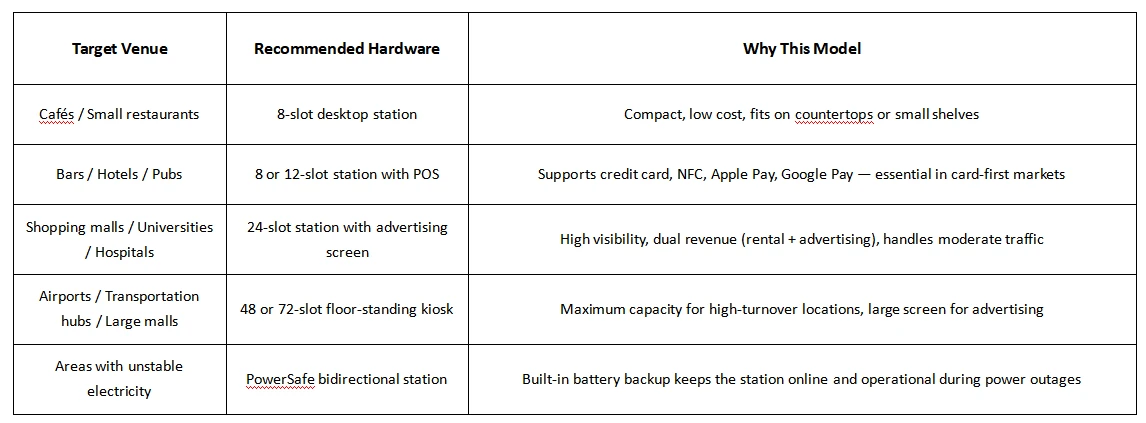
Hardware selection should be driven by your target venues, not by product specifications alone. Different locations have different space constraints, traffic volumes, and user expectations. The right station for a small café is completely wrong for an airport terminal.
Hardware Selection by Venue Type
Five Criteria for Evaluating an OEM Supplier
When choosing your hardware partner, price should not be the only consideration. Here are five critical checkpoints:
1. International certifications — CE (Europe), FCC (North America), UN38.3 (lithium battery transport), RoHS. Without these, your shipments may be held at customs and your stations cannot legally operate in many markets.
2. White-label customization capability — Can the supplier put your logo on the hardware, customize the app UI with your brand colors, and publish the app under your developer account? If not, you are building someone else's brand.
3. Software ownership — Is the rental system developed in-house by the manufacturer, or outsourced to a third party? In-house development means faster updates, better integration, and lower long-term risk.
4. Delivery timeline — Standard production and delivery should be within 30 days for stock models. Custom orders may take 45–60 days. Any supplier quoting 90+ days likely has capacity issues.
5. After-sales support coverage — Does the supplier offer technical support in your timezone? Is there remote troubleshooting capability? Are spare parts available for international shipping? These factors determine your operational uptime.
Common Hardware Mistakes to Avoid
•Choosing the cheapest station without checking certifications
•Selecting stations that do not support your market's payment methods
•Ignoring power bank capacity (below 5000mAh leads to poor user experience)
•Buying stations without advertising screens in premium locations (missed revenue)
•Not planning for spare parts and maintenance from day one
Not sure which station model is right for your target venues? Bajie Charging's sales team can recommend the optimal hardware configuration based on your market, venue types, and budget. Shared Power Bank Rental System | Global Supplier - BAJIE CHARGING !
Step 6: Set Up Your App, Software and Payment System
This is where shared power bank rental becomes a technology business rather than a simple hardware purchase. Your software and payment infrastructure determine user experience, operational efficiency, and ultimately — conversion rate and revenue.
1. User-Facing App / H5 Rental Page
Your users interact with the system through a mobile application or web-based H5 page. Core functions include:
•QR code scanning for instant rental initiation
•Nearby station finder with real-time availability
•Multiple payment methods (credit card, NFC, Apple Pay, Google Pay, local wallets)
•Order history and rental receipts
•Deposit management and automatic refunds
•Multi-language support for international markets
•Coupon and promotion system for user retention
The advantage of H5 web pages is that users do not need to download anything — they scan and rent immediately. For markets where app downloads are common, a native app provides better retention and push notification capabilities.
2. Admin Management System (Operator Backend)
The backend is your operational command center. A comprehensive admin system should include:
•Real-time station monitoring — online/offline status, power bank inventory, battery health
•Transaction management — all orders, payments, refunds, disputes
•Revenue analytics — daily/weekly/monthly income, per-station performance, trend analysis
•User management — registration data, rental history, deposit status
•Remote configuration — adjust pricing, rental rules, and deposit amounts without physical access
•Advertising management — upload and schedule ads on screen-equipped stations
•Alert system — notifications for offline stations, low inventory, or hardware faults
•OTA updates — push firmware updates to all stations remotely
•Battery health detection — monitor power bank degradation and schedule replacements
•Multi-level management — support for agents, sub-operators, and venue-level access
3. Payment System Integration
Payment is the single most critical conversion point. If a user cannot pay easily, they will not rent — regardless of how good your hardware is.
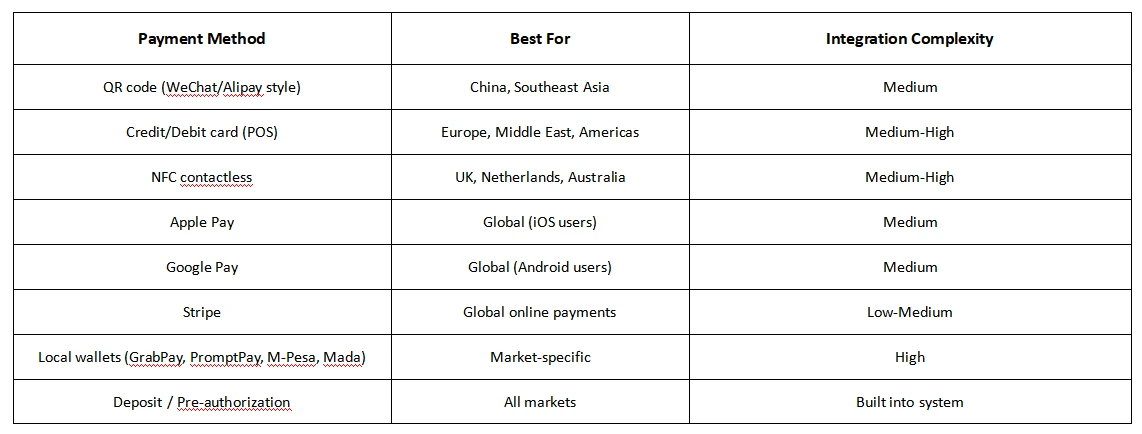
Critical insight: Payment friction is the number one killer of rental conversion. In card-first markets (Europe, Middle East), if your station only supports QR code scanning through an app, you will lose 60–80% of potential users. The payment method must match local habits.
Bajie Charging's system supports integration with 50+ payment gateways globally and provides technical guidance for connecting local payment processors in your target market.
Need Apple Pay, Google Pay, POS, or local payment gateway integration for your market? Bajie Charging provides complete technical support for payment system setup and configuration. Shared Power Bank Rental System | Global Supplier - BAJIE CHARGING !
Step 7: Deploy and Grow Your Shared Power Bank Network
With your market chosen, business model defined, hardware ordered, and software configured, it is time to deploy. The quality of your deployment strategy directly determines how quickly you reach profitability.
The Three-Look Principle for Station Placement
Look 1: Foot traffic volume — A minimum of 200 people passing through per day is the baseline for a viable location. Below this threshold, daily rental frequency will be too low to justify the station.
Look 2: Dwell time — Users need time to notice the station, decide to rent, and actually use the power bank. Restaurants (45–90 minutes average stay) outperform convenience stores (3–5 minutes). The longer people stay, the more likely they are to need charging.
Look 3: Decision-maker access — You need to negotiate with the person who has authority to approve station placement. In small restaurants, that is the owner. In shopping malls, that is the property management team. Do not waste time pitching to staff who cannot say yes.
Optimal Placement Within Venues
The exact position of your station within a venue matters significantly:
•Restaurants: Near the entrance, host stand, or waiting area — where people first sit down and check their phones
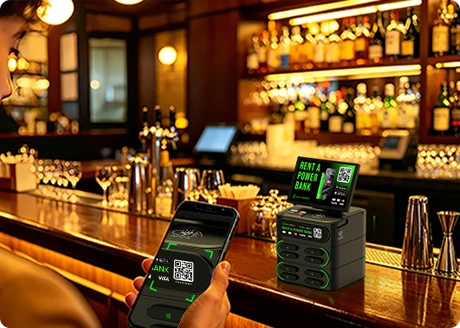
•Bars / Nightclubs: Bar counter, booth areas, near the DJ booth — where people spend hours
•Shopping malls: Escalator landings, food court entrances, cinema waiting areas
•Hotels: Front desk, lobby lounge, conference room entrances
•Airports: Gate waiting areas, departure lounges, arrival halls
First 90 Days: Deployment Strategy
Days 1–30: Concentrated pilotDeploy your first 10–30 stations in a single district or neighborhood. This creates network density — users can find return points easily, which increases their willingness to rent. Scattered deployment across an entire city creates a poor user experience.
Days 31–60: Data-driven optimizationMonitor your backend data daily. Identify which stations have the highest rental frequency and which are underperforming. Move underperforming stations to better locations. Test different pricing in different venues.
Days 61–90: Expansion phaseOnce you have identified your best-performing venue types and locations, replicate that formula. If restaurants in commercial districts perform best, focus your expansion on similar venues. Use your data to negotiate with new venue partners.
Key Performance Indicators to Track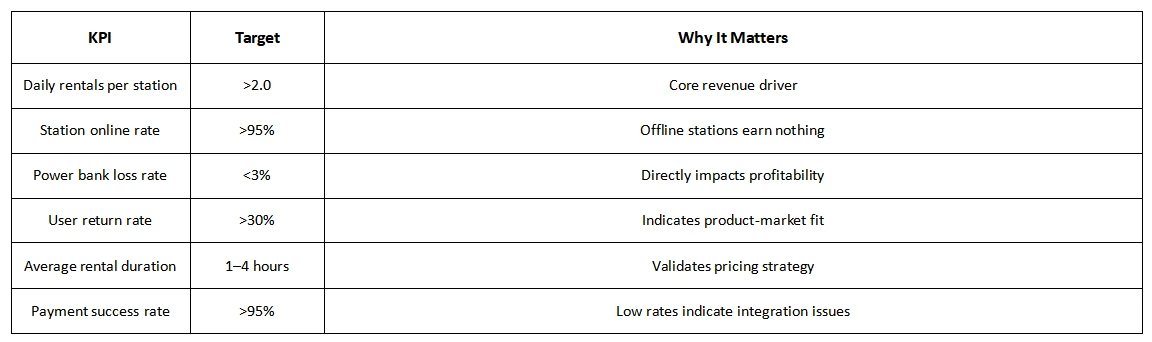
Common Mistakes When Starting a Power Bank Rental Business
After working with operators across 120+ countries, we have observed the same mistakes repeated by newcomers. Avoiding these errors can save you months of wasted time and thousands of dollars in lost investment.
Mistake 1: Testing with only 2–3 stationsThis is not enough to validate anything. Users who rent from one station need nearby return points. Without network density, the user experience is poor and your data is meaningless. Start with at least 10–30 stations in a concentrated area.
Mistake 2: Choosing hardware based solely on priceThe cheapest station often lacks critical certifications (CE, FCC), uses low-quality power banks that degrade quickly, and comes with unreliable software. The cost of replacing failed equipment and losing venue partnerships far exceeds the savings from buying cheap.
Mistake 3: Ignoring local payment habitsIf your target market uses contactless cards and your station only supports QR code scanning through a Chinese app, you have zero chance of success. Research how people pay in your market before selecting hardware and software.
Mistake 4: Not integrating POS or NFC in card-first marketsIn Europe, the Middle East, and Australia, users expect to tap their card or phone and go. Requiring app downloads or QR scanning in these markets creates unacceptable friction.
Mistake 5: Placing stations in low-traffic locationsA station in a quiet side street will never generate meaningful revenue regardless of how good your hardware is. Location quality is the single biggest determinant of success.
Mistake 6: Not building a return networkUsers are reluctant to rent if they are unsure where they can return the power bank. A single isolated station feels risky to users. Deploy in clusters so users can see multiple return options nearby.
Mistake 7: No maintenance and spare parts planStations need periodic maintenance. Power banks degrade over time. Cables wear out. If you have no plan for replacements and repairs, your station online rate will drop below 80% within six months.
Mistake 8: No ongoing technical supportWhen a station goes offline at 2 AM, who do you call? When your payment gateway has an error, who fixes it? Choosing a supplier without reliable after-sales support means every technical issue becomes your problem alone.
Why Choose Bajie Charging as Your Power Bank Rental Solution Partner?
Bajie Charging (Shenzhen Bajie Charging Technology Co., Ltd.) is not simply a charging station manufacturer. We provide a complete, end-to-end shared power bank rental business solution designed for global operators who want to build their own brands.
Manufacturing capability — Our 4,000㎡ production facility in Shenzhen produces the full range of shared power bank hardware, from compact 8-slot desktop stations to large 72-slot advertising kiosks. All products carry CE, FCC, RoHS, and UN38.3 certifications.
Complete product line — Desktop stations (4/6/8/12 slots), floor-standing stations (24/48/72 slots), POS-integrated models, advertising screen versions, outdoor weatherproof units, and the PowerSafe bidirectional station for markets with unstable electricity.
White-label everything — Your logo on the hardware. Your brand name on the app. Your colors in the UI. Your developer account on App Store and Google Play. Your payment gateway. Your data. You own the brand completely.
In-house software development — Our rental app, admin backend, and cloud infrastructure are developed and maintained by our own engineering team. This means faster customization, more reliable updates, and no dependency on third-party software vendors.
Global payment integration — We support 50+ payment gateways worldwide and provide technical guidance for integrating local payment processors including Stripe, Adyen, local bank APIs, and mobile money platforms.
After-sales commitment — 24/7 online customer service, 16-hour daily technical support, remote troubleshooting via backend access, spare parts international shipping, and video tutorial library for common maintenance tasks.
Proven global deployment — Our hardware and software systems are currently operating in 120+ countries, powering 100,000+ stations and serving 100 million+ end users through our partner network.
FAQ: Starting a Shared Power Bank Business
Q1: How much does it cost to start a shared power bank business?
The total startup cost depends on your market, station quantity, hardware model, payment method, software customization, and shipping destination. A small pilot with 10–30 stations typically ranges from $5,000–$20,000. A serious city-level launch with 50–100 stations usually requires $30,000–$80,000. Contact us with your specific requirements for an accurate quote.
Q2: Is a power bank rental business profitable in 2026?
Yes, when executed correctly. Profitability depends on location quality, rental pricing, payment convenience, and operational efficiency. Operators in high-traffic locations with proper payment integration typically achieve hardware payback within 4–8 months. The recurring nature of rental revenue makes this a sustainable long-term business.
Q3: How many stations should I start with?
We recommend starting with a minimum of 10–30 stations concentrated in one area. This creates the network density users need to feel confident renting (they need visible return points). Testing with only 2–3 stations does not generate reliable market data.
Q4: Can I use my own brand instead of the supplier's brand?
Yes. Bajie Charging specializes in OEM and white-label solutions. We can customize the hardware with your logo, build the app under your brand name, configure the backend with your branding, and publish the app under your own developer accounts on App Store and Google Play.
Q5: Can the app be published on App Store and Google Play under my brand?
Yes. We develop the app with your brand identity and assist with the submission process to both Apple App Store and Google Play Store under your own developer account. You retain full ownership.
Q6: What payment methods can be supported?
Our system supports QR code payment, credit/debit cards, NFC contactless, Apple Pay, Google Pay, POS terminals, Stripe, and local payment gateway integration. The specific methods configured depend on your target market's payment habits.
Q7: Can you integrate local payment gateways for my country?
Yes. We have experience integrating payment processors across 50+ countries and can provide technical guidance for connecting your local payment gateway, mobile money platform, or banking API to our rental system.
Q8: Do users need to download an app to rent a power bank?
Not necessarily. Our system supports both native app rental and H5 web-based rental (no download required). Users can scan a QR code and complete the entire rental process through their mobile browser. In markets where app downloads are common, the native app provides additional features like push notifications and loyalty programs.
Q9: Can users return power banks at different stations?
Yes. The system is designed for cross-station returns. Users can rent from one location and return to any other station within your network. The system automatically identifies the power bank, calculates the fee, and closes the order.
Q10: What certifications do your products have?
Our products carry CE (European conformity), FCC (US electromagnetic compatibility), RoHS (hazardous substance restriction), and UN38.3 (lithium battery transport safety) certifications. These are required for legal import and operation in most international markets.
Q11: What technical support do you provide after purchase?
We provide 24/7 online customer service, 16-hour daily technical support (remote troubleshooting via backend access), spare parts with international shipping, OTA firmware updates, and a video tutorial library covering common maintenance procedures.
Q12: How long does production and delivery take?
Standard models are typically ready for shipment within 15–20 days. Custom OEM orders (with branding, special configurations) usually require 30–45 days. Shipping time varies by destination — typically 15–30 days for sea freight or 5–7 days for air freight.
Ready to Launch Your Branded Power Bank Rental Business?
Starting a shared power bank rental business in 2026 requires more than buying machines. It requires the right market selection, the right business model, the right hardware for your venues, a reliable software platform, seamless payment integration for your users, and ongoing technical support to keep your network running at peak performance.
The operators who succeed are not those who find the cheapest hardware. They are those who build complete systems — hardware, software, payments, locations, and support — that deliver a frictionless experience to end users and generate predictable recurring revenue.
Bajie Charging helps global entrepreneurs, distributors, and operators launch branded power bank rental businesses with complete OEM and white-label solutions. From your first 10-station pilot to a 500-station national network, we provide the technology, manufacturing, and support infrastructure to get you from concept to revenue.
Your next step:
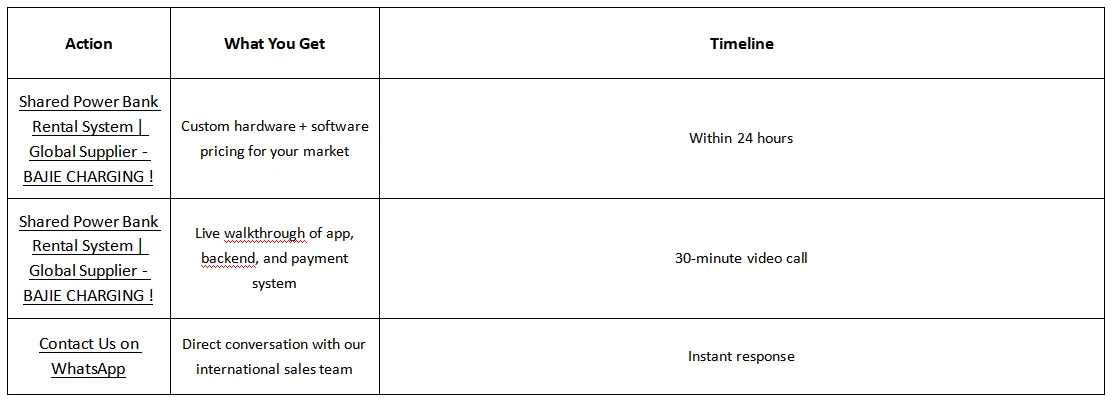
Tell us your target country, venue types, and desired scale — we will design a customized business plan for you.
Related reading:
•Power Bank Sharing Business ROI Calculator
•How to Choose a Shared Power Bank OEM Factory
•Shared Power Bank Business Cost Breakdown
•White-Label Power Bank Rental Solution
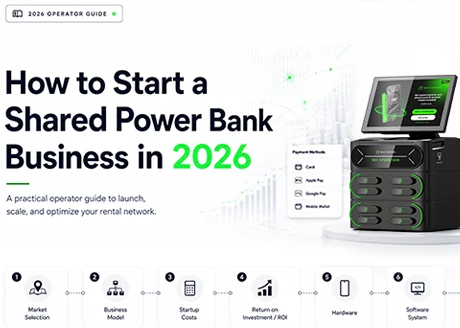 How to Start a Shared Power Bank Business in 2026: Cost, ROI, Hardware, App & Payment Guide
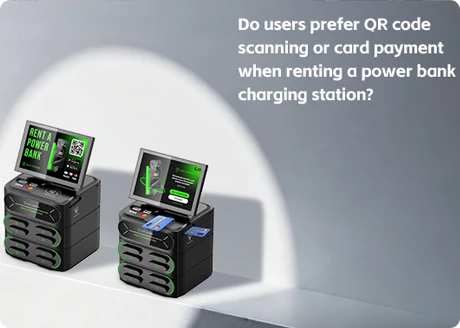 Do users prefer QR code scanning or card payment when renting from a power bank charging station?
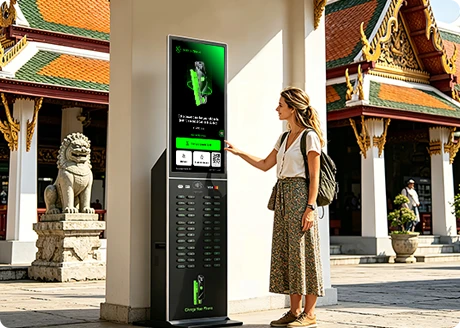 What are the advantages of deploying mobile charging stations in tourist attractions?
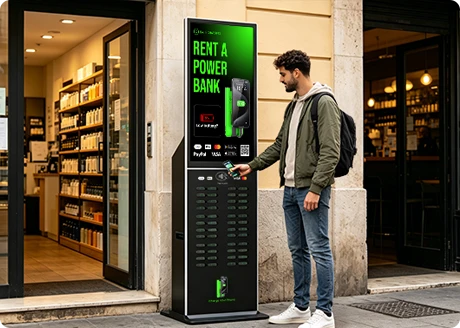 What Type of Phone Charging Station Equipment Is Best Suited for the Spanish Market?
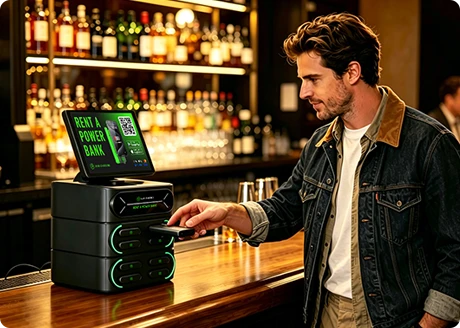 Which User Groups Are More Likely to Use Phone Charging Stations?
 How to Succeed in the Netherlands Phone Charging Station Market?